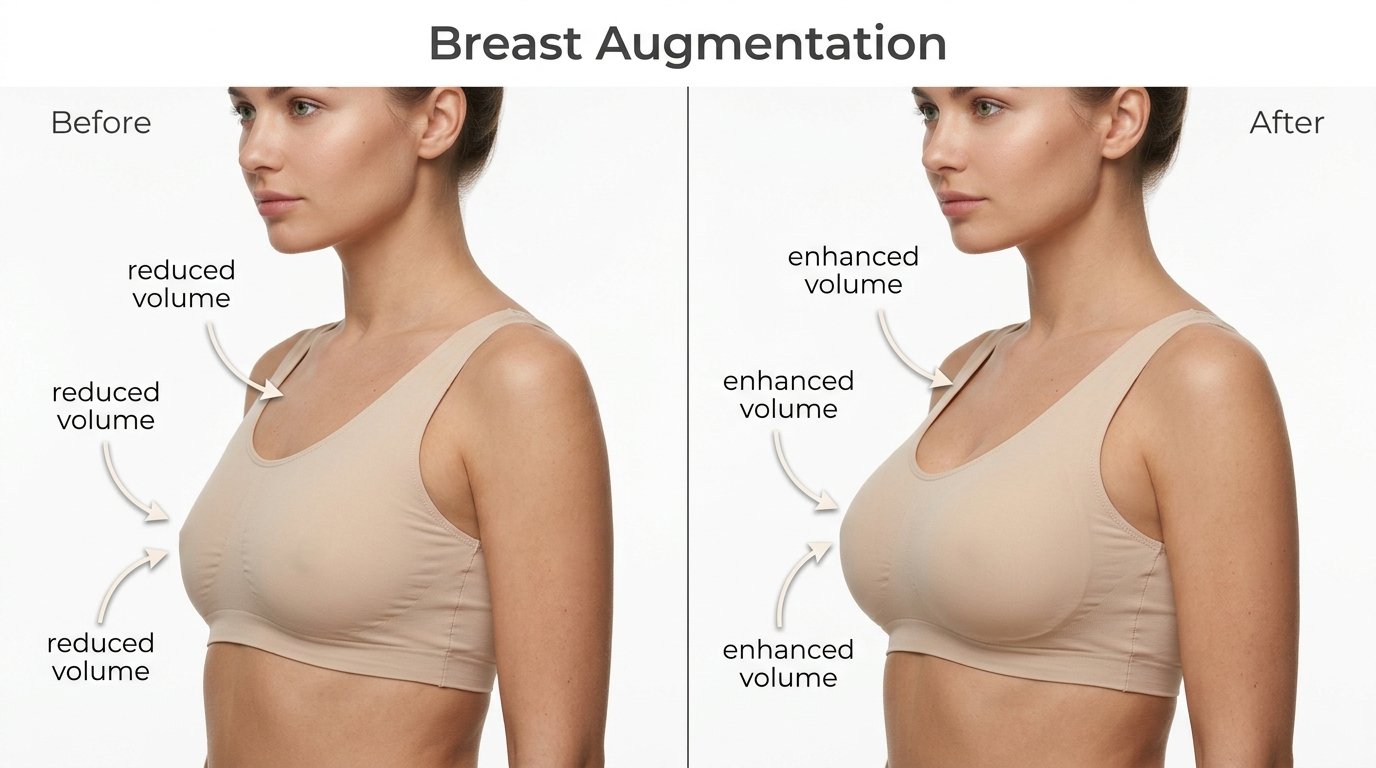
Breast augmentation — clinically known as augmentation mammaplasty — is one of the most performed aesthetic surgical procedures in the world, carried out under strict regulatory standards by internationally trained Consultant surgeons at accredited facilities.
This guide covers implant types, surgical approaches, candidacy criteria, and a week-by-week recovery timeline for breast augmentation.
Quick answer: Breast augmentation uses silicone or saline implants placed above or below the chest muscle to increase breast volume and improve proportion. Performed under general anaesthesia in 1–2 hours, desk work is resumable within 5–7 days and full activity by 6 weeks. Implant type, size, and placement are selected based on individual anatomy and goals, confirmed through a clinical consultation.
What Is Breast Augmentation?
Breast augmentation (augmentation mammaplasty) is a surgical procedure designed to increase breast volume, improve breast shape, or restore volume lost through pregnancy, breastfeeding, or significant weight change — using silicone or saline implants, or the patient’s own fat. It is one of the most requested cosmetic surgical procedures worldwide.
The procedure is not a substitute for a breast lift. Breast augmentation adds volume and improves projection, but it does not reposition sagging breast tissue (ptosis). Patients experiencing significant sagging may require a breast lift (mastopexy) or a combined augmentation-mastopexy, which is assessed individually during consultation. Conversely, patients with excessive breast tissue may benefit from breast reduction for hypertrophy to achieve proportion and relief.
Breast implant surgery is regulated under health-authority guidelines wherever it is performed — including requirements for licensed facilities, pre-operative screening, and the use of medically approved implant devices.
Why Do Women Choose Breast Augmentation?
Patients elect breast augmentation for a range of well-defined clinical and personal reasons. The most frequently cited include:
- Post-pregnancy and post-breastfeeding volume loss — glandular breast tissue often reduces significantly during and after lactation, leaving the breast deflated with reduced projection
- Post-weight-loss changes — substantial weight reduction frequently results in loss of breast fullness and skin laxity
- Breast asymmetry — structural size or shape differences between the two breasts, correctable by using different-sized implants or augmenting one side
- Proportional correction — patients whose breast volume is felt to be disproportionate to their overall body frame
- Underdevelopment (hypomastia) — breasts that did not develop to a size proportionate to the patient’s anatomy
- Reconstructive needs — following mastectomy, congenital anomalies such as tuberous breast deformity, or Poland syndrome
Psychological outcomes such as improved confidence are not guaranteed results of surgery and vary per individual.
Types of Breast Augmentation
Implant-Based Breast Augmentation
The most widely performed approach globally. Silicone or saline implants are placed in a surgically created pocket, providing precise control over size, shape, and projection. This is the primary choice for patients seeking a defined, durable volume increase.
Fat Transfer Breast Augmentation
Fat transfer breast augmentation harvests fat via liposuction from donor areas — typically the abdomen, flanks, or thighs — then purifies and injects it into the breast tissue.
- Uses only the patient’s own biological tissue — no implants required
- Eliminates implant-related complication risks (capsular contracture, rupture)
- Ideal for subtle, natural contouring and modest volume increase
- Volume gain is more limited compared to implant-based augmentation
- Requires sufficient donor fat and involves a dual-site procedure
The appropriate method is determined during a clinical assessment based on the patient’s anatomy, volume goals, and preference.
Types of Breast Implants
Implants vary across four dimensions: filling material, shape, surface, and profile. Each combination produces a different aesthetic outcome.
Filling Material
Silicone Implants The most popular choice worldwide. Cohesive silicone gel closely mimics the feel of natural breast tissue, reduces the risk of visible rippling, and maintains shape over time. Modern cohesive gel implants are designed to hold their form even if the outer shell is compromised.
Saline Implants Filled with sterile saltwater. Inserted empty into the pocket and filled to the desired volume during surgery, allowing a slightly smaller incision. If a rupture occurs, the saline is safely absorbed by the body, and deflation is immediately apparent — allowing timely identification and management.
Gummy Bear (Form-Stable) Implants Highly cohesive silicone that retains its shape definitively, even if the shell is breached. Anatomical by design, with a teardrop contour. Requires precise pocket positioning and a textured surface to prevent rotation.
Structured Saline Implants Contain an internal structure that improves the feel and reduces the rippling typical of traditional saline, offering a middle-ground option between saline and silicone.
Implant Shape
| Round | Anatomical (Teardrop) | |
|---|---|---|
| Volume distribution | Equal across upper and lower pole | More volume in lower pole, natural slope above |
| Appearance | Fuller upper breast, more defined cleavage | Natural breast silhouette, subtle enhancement |
| Movement | Moves freely — natural dynamic feel | Slightly more stable |
| Best suited for | Patients seeking visible fullness and projection | Patients prioritising a natural, unaugmented appearance |
| Rotation risk | None — symmetrical shape | Minimal; textured surface used to reduce rotation |
Implant Surface
Smooth Implants Produce a softer feel and more natural movement within the breast pocket. The most commonly used surface in modern practice, particularly for round implants.
Textured Implants A micro-rough surface encourages surrounding tissue adherence, reducing rotation risk — relevant primarily for anatomical (teardrop) implants that must maintain a fixed orientation.
Clinical note: Some macro-textured implants have been associated with BIA-ALCL (Breast Implant-Associated Anaplastic Large Cell Lymphoma). This has led to a significant shift in practice toward smooth and micro-textured surfaces. Implant surface selection is discussed during the pre-operative consultation in the context of each patient’s individual profile.
Implant Profile
Profile describes the relationship between the implant’s base width and its forward projection:
| Profile | Base Width | Projection | Best For |
|---|---|---|---|
| Low | Wide | Gentle | Broader chest frames, subtle result |
| Moderate | Balanced | Balanced | The most commonly selected profile |
| High | Narrow | Pronounced | Narrower frames; patients seeking greater projection |
Profile is selected based on the patient’s chest wall measurements and aesthetic goals — not chosen arbitrarily from a catalogue.
How Is the Right Implant Size Chosen?
Implant size selection is a collaborative process between patient and surgeon, grounded in anatomical measurement — not simply a number chosen from a list.
The surgeon assesses:
- Chest wall base width — the implant’s base diameter must be appropriate for the patient’s frame; implants too wide or too narrow for the chest wall create asymmetry and healing complications
- Existing breast tissue volume — the amount of native tissue determines how much coverage is available over the implant, which affects palpability and rippling risk
- Skin laxity — the degree to which the skin can be safely stretched to accommodate an implant
- Height and overall body proportions — implants are sized to complement the patient’s full silhouette, not evaluated in isolation
- Patient’s aesthetic goals — the degree of change desired, preference for natural vs. more prominent results
During consultation, implant sizers worn inside a bra provide a visual and tactile reference. The surgeon recommends a clinically appropriate size range; the final selection is made jointly. Requests for sizes outside the anatomically safe range are declined on clinical grounds.
Surgical Approaches
Incision Placement
Inframammary (Under the Breast Fold) — Most Commonly Used The incision is placed in the natural crease beneath the breast (the inframammary fold). Scars are concealed within the fold and are not visible when standing. This approach offers the widest choice of implant types and sizes, and gives the surgeon maximum visibility and direct pocket control. It is the most widely used incision approach.
Periareolar (Around the Nipple) The incision follows the lower border of the areola, where the natural colour transition camouflages the scar. Provides good access but carries specific considerations regarding nipple sensation and lactation, which are discussed during consultation.
Transaxillary (Armpit) The incision is placed in the natural axillary crease, leaving no visible scar on the breast. Requires specialised instrumentation and surgical experience. Suited to patients placing the highest value on absence of breast scarring.
Implant Placement
| Placement | Position | Appearance | Recovery |
|---|---|---|---|
| Subglandular | Above pectoralis major, beneath breast gland | Fuller, rounder upper pole; result visible sooner | Shorter, less post-op discomfort |
| Submuscular | Beneath pectoralis major | More natural slope; reduced palpability and rippling; better mammography imaging | Longer; more initial tightness |
| Dual-Plane | Upper pole submuscular; lower pole subglandular | Balanced natural result; combines upper-pole slope with lower-pole fullness | Intermediate |
The appropriate placement is selected based on the patient’s existing breast tissue volume, skin quality, chest anatomy, and aesthetic goals.
Who Is the Ideal Candidate for Breast Augmentation?
Breast augmentation candidacy requires a full anatomical and medical assessment. Patients who are generally suitable share these characteristics:
- Adults with fully developed breasts — typically 18 or above for saline; 22 or above for silicone implants, in line with international clinical guidance
- At or near a stable, healthy body weight — significant post-operative weight fluctuation alters how the implants sit and can affect the result
- Not currently pregnant or breastfeeding
- Non-smoker, or willing to cease smoking prior to surgery — smoking impairs tissue perfusion, wound healing, and anaesthetic safety
- Good general health with no uncontrolled systemic conditions
- Realistic expectations — implants improve volume, shape, and proportion; they do not halt ageing or gravity over time
Who may not be an appropriate candidate: Patients primarily concerned with breast position rather than volume — those with significant ptosis (sagging) — are often more appropriately served by a breast lift (mastopexy) alone or a combined augmentation-mastopexy. Patients with active infection, untreated systemic disease, or unrealistic expectations are not suitable candidates. Suitability is always confirmed through individual clinical assessment; no self-assessment is substitutable for consultation.
Patients who have experienced significant volume loss alongside sagging may also wish to explore breast reduction or combined procedures — discuss all options during a personal consultation.
How Is Breast Augmentation Surgery Performed?
Pre-Operative Assessment
A comprehensive clinical evaluation precedes all surgery. The surgeon reviews the patient’s full medical and surgical history, performs an anatomical breast assessment, documents baseline anatomy through standardised clinical photography, confirms implant selection (type, size, shape, profile, surface, and placement plane), outlines all associated surgical risks and realistic expected outcomes, and obtains written informed consent. Pre-operative blood investigations and an anaesthetic assessment are arranged as required.
Anaesthesia
Breast augmentation is performed under general anaesthesia in a DHA-licensed surgical facility. The anaesthetic plan is tailored to the scope of the procedure and each patient’s individual clinical profile by the attending anaesthetist.
Surgery
Once anaesthesia is confirmed and safety checks completed, the surgeon makes the planned incision, creates a precise pocket in the appropriate plane (subglandular, submuscular, or dual-plane), positions the implant, confirms symmetry bilaterally, and closes all tissue layers with absorbable sutures. A sterile dressing and supportive surgical bra are applied. Total operating time is typically 1–2 hours.
Post-Operative Monitoring
The patient is monitored in the recovery unit before transfer to the ward. Once clinically stable, the patient is prepared for discharge with detailed written post-operative instructions, prescribed medication, and a scheduled follow-up appointment. In the majority of cases, patients are discharged the same day.
What Is the Recovery Timeline After Breast Augmentation?
Recovery from breast augmentation is progressive. The following represents a typical post-operative course; individual recovery varies according to implant placement, technique used, and each patient’s general health and compliance with aftercare guidance.
Days 1–3: Rest is essential. Swelling, tightness, and moderate discomfort are expected — particularly for submuscular placements where the pectoral muscle is involved and must adjust to the implant beneath it. Prescribed analgesia manages pain effectively. The surgical bra is worn continuously. Short, gentle walks around the home are encouraged from day one to support circulation and reduce the risk of deep vein thrombosis.
Days 4–7: Most patients can manage independently for routine daily tasks — washing, light meal preparation, and personal hygiene. Swelling typically peaks and then begins to subside. Lifting objects above shoulder height is avoided. A first post-operative review with the surgical team is usually scheduled during this window to assess healing and wound status.
Weeks 2–3: Swelling continues to reduce progressively. Most patients with desk-based roles return to work by the end of week two. Overhead arm movements, heavy lifting, and cardiovascular exercise remain restricted. Driving is typically resumed when the patient is comfortable and unimpaired by medication — usually by the end of week two, subject to surgeon sign-off.
Weeks 4–6: Physical restrictions are progressively lifted under surgical team guidance. The surgical bra is worn for the full six-week period. By week six, the majority of patients have returned to full daily activity, including moderate exercise.
Months 2–3: Residual swelling resolves fully. Implants settle into their final position within the pocket and soften as the surrounding capsule matures. The natural breast silhouette becomes progressively more apparent.
Month 6: Final results are stable and fully visible. Scar maturation continues for 12–18 months post-operatively. Scars lighten significantly with proper care and sun protection.
General recovery guidance throughout:
- Sleep on the back with the upper body slightly elevated during the initial recovery period
- Attend all scheduled post-operative appointments without exception
- Follow the wound care and medication protocol provided at discharge
- Avoid direct sun exposure on incision sites throughout the healing period
Breast Augmentation with a Breast Lift — When Is a Combined Procedure Needed?
Patients who present with both volume loss and breast ptosis (sagging) — a common presentation following pregnancy, breastfeeding, or significant weight loss — often require a combined augmentation-mastopexy procedure. Breast augmentation alone in a patient with significant ptosis can result in an unsatisfactory outcome: volume is added but position is not corrected, and the implant may sit too low.
The combined procedure addresses both issues simultaneously — implants restore volume and projection; mastopexy repositions the nipple-areola complex and removes excess skin. Planning requires careful coordination of the two components, as each influences the other’s outcome.
For patients in whom a lift is required but implants are not desired, the Chignon Mastopexy — a published glandular breast lift technique (Aesthetic Plastic Surgery, 2018) — can restore central breast volume and projection using the patient’s own glandular tissue, without synthetic implants. Full details are in the dedicated Chignon Mastopexy guide.
Breast Augmentation, Breast Lift, or Fat Transfer — Which Is Right?
| Consideration | Breast Augmentation | Breast Lift (Mastopexy) | Fat Transfer |
|---|---|---|---|
| Primary goal | Increase volume | Reposition and reshape | Subtle volume increase |
| Addresses sagging | No — may worsen if significant ptosis present | Yes | No |
| Addresses volume loss | Yes | No (unless combined) | Yes — modest gain |
| Implants required | Yes | No | No |
| Uses own fat | No | No | Yes |
| Degree of volume change | Significant | None | Modest |
| Scarring | Depends on incision | Yes — depends on technique | Minimal |
| Downtime | 4–6 weeks | 4–6 weeks | 2–4 weeks |
| Can be combined | Yes (with lift or fat grafting) | Yes (with augmentation) | Yes (with lift) |
The appropriate recommendation is made individually following anatomical assessment. Many patients benefit from a combination of approaches.
What Do Breast Augmentation Before and After Results Look Like?
Before surgery, the surgical team documents each patient’s baseline anatomy through standardised clinical photography. Post-operative photography is conducted at scheduled intervals as healing progresses — providing a consistent visual record across the recovery timeline.
DHA regulatory requirements for before and after images: Under Dubai Health Authority and Ministry of Health standards, before and after images published by licensed clinics must be unaltered, must represent the actual patient treated, and must carry the following notice:
“There is no guarantee that the result will be the same, as it might vary from one individual to another.”
When reviewing breast augmentation before and after photographs — whether on clinic websites or social media — patients should be aware that photography conditions materially affect how results appear. Lighting angle, posture, distance, and the stage of recovery at the time of photography all influence the image. Photographs taken at 6–12 months post-operatively provide the most representative view of the final healed outcome. Images taken in the first weeks of recovery reflect swelling, not final results.
View before and after results →
What Are the Risks of Breast Augmentation?
All surgical procedures carry inherent risk. Specific considerations with breast augmentation include:
- Capsular contracture — the body forms scar tissue around all implants (a capsule); in some cases this capsule tightens excessively, causing hardness, distortion, or discomfort. One of the most common long-term complications requiring revision
- Implant rupture or deflation — implant shell integrity can be affected over time; modern implants have improved significantly. Routine ultrasound or MRI imaging allows early detection
- Implant displacement or malposition — movement of the implant from its planned position, more common with anatomical implants if pocket control is inadequate
- Changes in nipple or breast sensation — temporary in the majority of cases; rarely longer-lasting. Depends on incision site and individual nerve anatomy
- Asymmetry — minor healing differences between each side are common; significant asymmetry requiring revision is less frequent
- Visible or hypertrophic scarring — influenced by incision choice, individual healing response, and post-operative care
- Infection — rare in accredited facilities under sterile conditions; managed with antibiotics or, in severe cases, temporary implant removal
- Seroma or haematoma — fluid or blood accumulation around the implant, typically resolving with drainage
- Anaesthetic risks — assessed and minimised during the pre-operative assessment
Safety & Regulatory Standards
- All surgeons must operate under current DHA and MOH licence
- Medical-grade implants approved by international regulatory bodies (CE-marked; FDA-cleared)
- Sterile surgical environments with pre-operative screening as standard
Choosing a DHA-licensed facility and an EBOPRAS-certified Consultant plastic surgeon with documented experience in breast surgery substantially reduces procedural risk. All risks are reviewed comprehensively and individually during the pre-operative consultation.
According to ASPS and ISAPS clinical data, serious complications are uncommon when procedures are performed in appropriately accredited settings by qualified surgeons. Individual risk profiles vary. Peer-reviewed studies in Plastic and Reconstructive Surgery have demonstrated that breast augmentation performed by board-certified plastic surgeons in accredited facilities has excellent safety profiles with low complication rates when proper patient selection and surgical protocols are followed.
How Long Do Breast Implants Last?
Modern breast implants do not carry a fixed expiry date. They are engineered to last 10–15 years or more under normal conditions, and do not require routine replacement on a set schedule.
Replacement may be clinically indicated if:
- Rupture or deflation is confirmed by ultrasound or MRI imaging
- Capsular contracture progresses to a degree that causes pain, distortion, or patient dissatisfaction
- Implant malposition or displacement cannot be managed conservatively
- Patient preference changes — a desire to alter size, shape, or to remove implants entirely
- Significant anatomical change — substantial weight gain or loss, or further pregnancies, altering how the implant sits
Regular follow-up appointments are recommended. The surgeon will advise on appropriate imaging intervals based on implant type and individual clinical history. Patients should not wait for symptoms to present before attending a review if they have any concerns.
How to Choose a Qualified Breast Augmentation Surgeon
The choice of surgeon is the single most important decision in the breast augmentation process. Patients should verify:
- Board certification in plastic surgery — specifically from a recognised European (EBOPRAS) or equivalent international body — not a general medical licence
- Consultant experience in breast surgery — a surgeon with documented high-volume breast surgery experience, not a generalist performing occasional breast procedures
- Published clinical work — peer-reviewed publication in recognised journals is a reliable signal of advanced surgical knowledge
- Before and after documentation — ask to see documented patient results at 6–12 months post-operatively, not images taken immediately post-surgery
- Transparent pre-operative consultation — a surgeon who discusses risks, limitations, and alternatives fully — not one who only focuses on positive outcomes
- Accredited surgical facility — a licensed operating theatre, not a clinic treatment room, and a current health-authority licence held by the operating surgeon
Related procedures:
- Breast Lift (Mastopexy) Dubai — For patients with ptosis or post-pregnancy sagging
- Breast Reduction Dubai — For patients seeking reduced volume and improved proportion
- Before & After Gallery — View documented breast augmentation results
- Breast Augmentation in Dubai — Full procedure details, surgeon credentials, and consultation booking
- Book a Consultation — Start with a personal clinical assessment
Book a Consultation for a comprehensive anatomical breast assessment and personalised treatment plan.
Further reading:
- Breast Lift Dubai — Complete Guide — When a lift is the right approach, and the Chignon Mastopexy explained in full
- Chignon Mastopexy Dubai — The published glandular lift technique that avoids implants
- Fat Grafting in Dubai — Natural volume enhancement as an alternative or complement to implants
- Cosmetic Surgery in Dubai — Overview of all procedures, costs, and surgeon selection criteria
Medical References
- American Society of Plastic Surgeons (ASPS)
- International Society of Aesthetic Plastic Surgery (ISAPS)
- American College of Surgeons (ACS)
- American Board of Plastic Surgery (ABPS)
- The Chignon Mastopexy: A Double Glandular Suspended Flaps for an Auto-Augmentation Effect — PubMed
Medical Disclaimer: This information is for general educational purposes only. Individual results, recovery timelines, and candidacy depend on anatomy and medical history. A clinical consultation with a DHA-licensed EBOPRAS-certified surgeon is required before any procedure. Results are not guaranteed.
Frequently Asked Questions
Which breast implants are most popular?
Silicone implants are the most commonly chosen option worldwide, as cohesive silicone gel closely mimics the feel of natural breast tissue, reduces the risk of rippling, and maintains shape over time. The appropriate implant type is confirmed during an individual anatomical assessment.
What is the safest incision approach for breast augmentation?
The inframammary incision — placed in the natural crease beneath the breast — is the most frequently used approach. It offers the surgeon maximum visibility and control, accommodates the widest range of implant types, and places the scar in a naturally concealed location.
How long is the recovery from breast augmentation?
Most patients return to desk-based work within 5–7 days. Light activities resume at 2–3 weeks. Full physical activity, including strenuous exercise, is typically cleared at 4–6 weeks. Individual recovery varies based on implant placement, surgical technique, and general health.
Is breast augmentation surgery painful?
The procedure is performed under general anaesthesia — there is no pain during surgery. Post-operatively, the sensation is more of tightness and pressure than sharp pain, particularly for submuscular placements. Discomfort is effectively managed with prescribed medication.
Can I breastfeed after breast augmentation?
In most cases, yes. The incision type and implant placement are planned to preserve breastfeeding capacity wherever possible. Patients intending to breastfeed should discuss this during the pre-operative consultation so the surgical approach can be planned accordingly.
Do breast implants feel natural?
High-quality cohesive silicone implants feel soft and natural once fully healed and settled, particularly when placed in the submuscular or dual-plane position. The degree of natural feel depends on implant type, size, placement, and the amount of existing breast tissue coverage.
Is breast augmentation surgery safe?
When performed in an accredited facility by a qualified, board-certified surgeon, breast augmentation follows strict regulatory standards. Pre-operative screening, medical-grade implants, and sterile surgical environments are required under recognised health-authority guidelines.
What is the difference between breast augmentation and a breast lift?
Breast augmentation increases breast volume using implants or fat transfer. A breast lift (mastopexy) repositions and reshapes existing breast tissue to address sagging, without significantly changing volume. Patients with both volume loss and ptosis may benefit from a combined augmentation-mastopexy, assessed individually.
How long do breast implants last?
Modern breast implants are designed to last 10–15 years or more. They do not carry a fixed expiry date and do not routinely require replacement unless complications develop — such as capsular contracture, rupture, or significant change in shape. Regular follow-up appointments are recommended.
What are the risks of breast augmentation?
Risks include capsular contracture, implant rupture or displacement, temporary or permanent changes in nipple sensation, asymmetry, scarring, and anaesthetic risks. All risks are reviewed comprehensively during the pre-operative consultation. Experienced, DHA-licensed surgeons apply rigorous technique to minimise complications.
Who is the ideal candidate for breast augmentation?
Good candidates are adults with fully developed breasts seeking increased volume, symmetry correction, or restoration of post-pregnancy or post-weight-loss volume. Candidates should be in good general health, non-smokers, not pregnant or breastfeeding, and hold realistic expectations. Suitability is confirmed through individual anatomical assessment.
Related Clinical Articles
Breast Lift Guide: Mastopexy Explained
A clinical guide to breast lift (mastopexy): techniques, the Chignon method, candidacy, and week-by-week recovery timeline.
May 15, 2026
Chignon Mastopexy: The Advanced Glandular Breast Lift
Chignon Mastopexy Dubai: Expert guide on the glandular flap technique for an internal breast lift. Restore projection without implants or mesh. EBOPRAS authority.
Jun 14, 2026