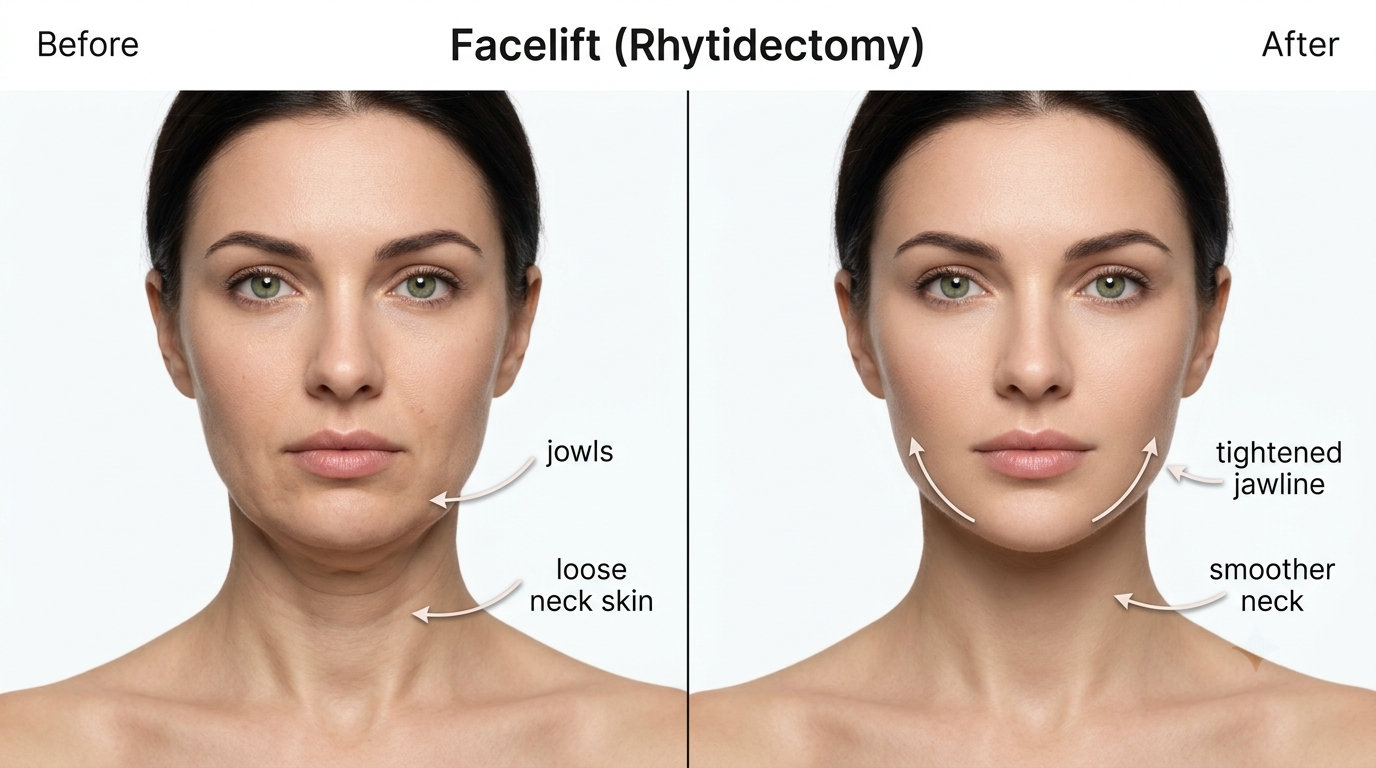
Quick answer: A deep plane facelift repositions the deeper connective tissue layers of the face — including the SMAS and mid-face composite — rather than simply tightening the skin surface.
A facelift — clinically known as rhytidectomy — is the surgical gold standard for facial ageing. In Dubai, patients increasingly seek advanced techniques that address the deep structural changes of ageing rather than surface skin tightening alone. The deep plane facelift, which repositions the SMAS and mid-face tissue composite together as a single unit, has become the preferred approach for patients with moderate-to-significant facial descent.
This guide covers the difference between deep plane, SMAS, and mini facelift techniques; addresses the most-searched questions (including “What is a Dubai facelift?”, “9D facelift”, and non-surgical alternatives); and explains what to expect from facelift surgery at a DHA-licensed facility in Dubai. For comprehensive facial rejuvenation options, explore our facial procedures section.
What Is a Deep Plane Facelift?
A deep plane facelift releases and repositions the SMAS (Superficial Musculo-Aponeurotic System) together with the overlying soft tissue composite — including fat and skin — as a single unit. This differs from standard SMAS plication or imbrication techniques, which manipulate the SMAS layer alone without releasing the retaining ligaments.
By releasing the zygomaticocutaneous and masseteric ligaments that tether the mid-face, a deep plane technique:
- Restores deflated mid-face volume to the cheeks and tear troughs
- Corrects jowl formation at the jawline through structural rather than skin tension
- Improves the nasolabial folds by repositioning the tissue composite rather than pulling the skin
- Addresses the neck when combined with platysmaplasty (platysma muscle tightening)
The result is a more comprehensive, natural-looking rejuvenation that avoids the “windswept” or “operated” appearance associated with skin-only techniques. Because there is no tension on the skin surface itself, the risk of visible scarring and unnatural contour distortion is significantly reduced.
Deep Plane Facelift vs. SMAS Facelift: What Is the Difference?
| Feature | SMAS Facelift | Deep Plane Facelift |
|---|---|---|
| Layer addressed | SMAS below skin | SMAS + soft tissue composite |
| Retaining ligament release | Partial | Complete (zygomatic + masseteric) |
| Mid-face correction | Moderate | Comprehensive |
| Nasolabial fold improvement | Moderate | Significant |
| Longevity | 5–8 years typical | 8–12 years typical |
| Recovery to social | 2–3 weeks | 2–3 weeks (similar) |
| Best suited for | Mild-moderate laxity | Moderate-significant laxity |
| Skin tension | Some | Minimal |
The appropriate technique depends on the patient’s anatomy, degree of descent, skin quality, and treatment goals — determined during clinical assessment, not by age alone. For patients concerned with periocular ageing, blepharoplasty may be combined with facelift for comprehensive results.
What Is a “Dubai Facelift”?
The term “Dubai facelift” circulates widely on social media and in online forums. It does not describe a defined surgical technique or a procedure unique to Dubai.
The phrase typically refers to one of:
- Non-surgical aesthetic protocols — combinations of thread lifts, HIFU, radiofrequency treatments, and injectable fillers offered by aesthetic clinics and marketed under branded names (“Dubai lift”, “9D lift”, etc.)
- A social media attribution — commentary on celebrities appearing rejuvenated after visiting Dubai, attributed to aesthetic treatments
- Thread lift procedures — minimally invasive techniques using barbed sutures to produce a temporary lifting effect
A genuine surgical facelift performed in Dubai by a DHA-licensed, EBOPRAS-certified consultant plastic surgeon uses deep-plane or SMAS rhytidectomy — the same evidence-based techniques applied at leading academic centres in France, the UK, and North America. “Dubai facelift” is a marketing construct, not a clinical classification.
For patients researching facelift options in Dubai, the distinction matters: non-surgical protocols produce temporary results in mild laxity, while deep plane surgery produces structural correction lasting 8–12 years.
Who Is a Good Candidate for Facelift Surgery in Dubai?
A facelift is clinically appropriate for patients with:
- Noticeable mid-face descent — flattening of the cheeks, deepening nasolabial folds
- Jowl formation — soft tissue descent at the jawline creating a scalloped or blurred outline
- Neck skin laxity — loose skin, visible platysma bands, or poor neck-jaw angle
- Good skin quality — sufficient skin elasticity for safe repositioning
- Stable general health — no active medical contraindications to surgery or anaesthesia
- Non-smoking status — or willingness to stop smoking 4+ weeks before and after surgery (smoking impairs wound healing and significantly increases complication risk)
- Realistic expectations — understanding of what surgery can and cannot correct
Most patients are in their 40s–60s, though this is a guide, not a requirement. A 45-year-old with significant laxity may benefit from a full deep plane procedure; a 60-year-old with minimal changes may be better suited to a mini facelift. Anatomy determines suitability — not calendar age.
Contraindications include uncontrolled medical conditions, active skin infection in the treatment area, blood-thinning medications that cannot be safely paused, and unrealistic surgical expectations.
Mini Facelift vs. Deep Plane Facelift in Dubai
Mini facelift (limited-incision facelift):
- Short incisions within or around the ear
- Targets early or moderate jowling and lower facial laxity
- Recovery approximately 1–2 weeks before social return
- Less operative time and anaesthesia exposure
- Appropriate for early-stage laxity in patients typically in their 40s–early 50s
Deep plane facelift:
- Full incision (temple hairline to behind the ear into the occipital scalp)
- Addresses mid-face, jawline, jowls, and neck comprehensively
- Recovery 2–3 weeks before social return; full result at 3–6 months
- Results last 8–12 years with proper ligament release
- Appropriate for moderate-to-significant mid-face and lower facial descent
Neither technique is inherently “better” — the right choice depends entirely on what the anatomy requires. A mini facelift on a patient who needs a full deep plane procedure produces an undercorrected result. A deep plane procedure on someone with early laxity is more intervention than necessary. Clinical assessment determines which approach is appropriate.
Which Country Is Best for Facelift Surgery?
Dubai is among the top global destinations for facelift surgery for three structural reasons:
1. Regulatory standards The Dubai Health Authority (DHA) requires all plastic surgeons to hold a valid specialist licence and all surgical facilities to meet defined accreditation standards. Unlike unregulated medical tourism destinations, Dubai mandates credentials verification before a surgeon is permitted to perform invasive procedures.
2. Board certification EBOPRAS (European Board of Plastic, Reconstructive and Aesthetic Surgery) is the gold standard certification for plastic surgeons practicing across Europe and the Gulf. EBOPRAS-certified surgeons in Dubai hold the same credentials as those practicing in France, Germany, and the UK.
3. Deep plane expertise Deep plane facelift technique requires advanced anatomical training in ligament anatomy and SMAS dissection. Surgeons with international faculty experience bring the same technical level found at major academic centres in Paris and London.
Patients from France, Switzerland, and across the GCC regularly travel to Dubai specifically for deep plane facelift surgery — attracted by DHA-regulated safety, EBOPRAS credentials, and world-class facility infrastructure.
Non-Surgical Facelift Options in Dubai
For patients who are not surgical candidates, or who prefer non-invasive approaches, Dubai offers several non-surgical options:
| Treatment | Mechanism | Duration of result | Best suited for |
|---|---|---|---|
| Thread lift | Barbed absorbable sutures | 12–18 months | Mild laxity, younger patients |
| HIFU | Focused ultrasound to SMAS level | 6–12 months | Mild-moderate laxity |
| Radiofrequency | Thermal collagen stimulation | 6–12 months | Mild skin laxity |
| Filler repositioning | Volume restoration | 9–18 months | Mid-face deflation |
| Combination protocol (“9D lift”) | Multiple modalities | 12–18 months | Mild-moderate changes |
Non-surgical treatments do not reproduce the anatomical repositioning achieved by surgery. They are most appropriate for patients with mild laxity, those who are not suitable surgical candidates medically, or those who wish to delay surgery. A clinical consultation determines which approach is appropriate for each patient’s anatomy.
What Is a 9D Facelift in Dubai?
A 9D facelift is a branded, trademarked non-surgical protocol combining multiple modalities — typically HIFU, radiofrequency, thread lifting, and/or injectable treatments — delivered in one session or a structured series. The “9D” designation is a marketing construct and does not correspond to an anatomical classification or a peer-reviewed surgical technique.
Clinical outcomes vary significantly between providers. Results are temporary and are not equivalent to a surgical deep plane or SMAS facelift in terms of correction depth or longevity.
Patients considering a 9D facelift should evaluate it as a non-surgical option with limited and temporary correction, and discuss surgical candidacy during a clinical consultation if longer-lasting structural results are the goal.
How Long Does a Deep Plane Facelift Last?
Result longevity depends on:
- Technique — Complete ligament release in deep plane surgery reduces soft tissue re-descent compared to surface tightening
- Skin quality — Good dermal thickness and elasticity at the time of surgery extends results
- Sun exposure — Chronic UV damage accelerates skin laxity and collagen degradation
- Smoking — Nicotine impairs collagen synthesis and accelerates facial ageing post-operatively
- Weight stability — Significant weight fluctuation after surgery alters facial volume and may affect the result
- Individual ageing biology — Genetic rate of tissue descent varies
Deep plane facelifts, when performed with correct anatomical ligament release, typically maintain meaningful correction for 8–12 years. Secondary procedures, when needed, are less extensive than the original surgery. Many patients supplement their surgical result with injectables or HIFU in the years following surgery before considering a revision procedure.
Deep Plane Facelift Recovery: Week-by-Week Timeline
| Timeline | What to expect |
|---|---|
| Day 1–3 | Bandages in place. Rest, head elevation, limited movement. Swelling and bruising at maximum. |
| Week 1 | Bandages removed by surgeon. Drains removed if used. Sutures partially removed. Swelling prominent but pain minimal. |
| Week 2 | Bruising begins to fade. Most patients are comfortable at home. Light activity resumed. |
| Week 3 | Social return possible with makeup. Compression garment or garment removed depending on protocol. |
| Weeks 4–6 | Progressive recovery. Light exercise permitted. Swelling and firmness continuing to resolve. |
| Month 3 | Result clearly visible. Residual swelling gone. Scars settling. |
| Month 6 | Final result. Scars faded to near-invisible. Full assessment of outcome. |
Individual recovery depends on the extent of the procedure, whether neck surgery was combined, skin quality, and adherence to the post-operative protocol established during consultation.
How Much Does a Deep Plane Facelift Cost?
The cost depends on the surgical technique required, the complexity of the individual case, anaesthesia, facility standards, and whether procedures are combined (facelift + neck lift, facelift + blepharoplasty, etc.). An accurate assessment requires an individual clinical evaluation.
Competitors list prices; at Seline Clinic, Jumeirah, cost is discussed only after an individual clinical assessment — because the same procedure description can involve very different technical demands depending on anatomy.
Deep Plane Facelift Before and After: What to Expect
Following deep plane surgery, patients typically observe:
- Weeks 2–3: Initial result visible as swelling begins to resolve. Jawline definition and neck contour are already noticeably improved.
- Months 1–3: Mid-face fullness restores as volume repositions. Nasolabial folds flatten progressively.
- Month 3–6: Final result — sharply defined jawline, restored cheek projection, improved neck contour with no residual swelling. Scars, placed within the hairline and around the ear, fade to near-invisible.
The result should look like a younger, rested version of the patient — not a different person. Deep plane repositioning without skin tension produces a natural aesthetic that is difficult to achieve with surface techniques.
Clinical before and after results are available for review during consultation. No surgical outcome can be guaranteed; results depend on individual anatomy, healing response, and technique.
Combining Facelift with Neck Lift and Blepharoplasty
A facelift alone addresses the mid-face, lower face, and jowl region. For patients seeking comprehensive facial rejuvenation, the following combinations are frequently performed in a single session:
Facelift + Neck lift (cervicoplasty) The most common combination. Addresses the face and neck together for consistent rejuvenation that “reads” naturally. Neck lift adds platysmaplasty (platysma tightening) and submental liposuction where indicated. See the neck lift Dubai guide for full details.
Facelift + Blepharoplasty Eyelid surgery addresses the upper and lower eyelid regions, which the facelift does not reach. The combination produces a full periocular and lower facial rejuvenation in one recovery period.
Facelift + Fat grafting Volume loss is a primary component of facial ageing alongside tissue descent. Fat transfer to the temples, under-eye troughs, and mid-face restores deflation that lifting alone cannot address.
Whether combining procedures is appropriate depends on the scope of each procedure, total operative time, and individual medical profile — determined during clinical assessment.
Medical disclaimer: This article is provided for patient education purposes. Suitability for surgery, technique selection, recovery expectations, and aesthetic outcomes depend on individual anatomical factors, health status, and personalized surgical planning. A consultation with a DHA-licensed Consultant is required before any procedure.
Related procedures and guides:
- Facelift (Rhytidectomy) — Full procedure details, candidacy, and risks
- Neck Lift — Comprehensive cervicoplasty and platysmaplasty guide
- Eyelid Surgery (Blepharoplasty) — Periocular rejuvenation
- Facial Surgery — All facial procedures overview
- Before & After Gallery — Clinical results documentation
- Book a Consultation — Private clinical assessment at Seline Clinic, Jumeirah
Frequently Asked Questions
How much does a facelift cost?
The cost of a facelift depends on the surgical technique required (deep plane, SMAS, or mini facelift), the complexity of the individual case, anaesthesia, facility standards, and whether procedures are combined. An accurate assessment requires an individual clinical evaluation — not a general price list.
Which country is best for face lift surgery?
Dubai is among the top global destinations for facelift surgery due to DHA regulatory standards, EBOPRAS-certified Consultants, and world-class facility infrastructure. For patients in the UAE and GCC, Dubai eliminates post-operative travel risk while providing access to internationally board-certified surgeons with the same credentials as those practising in France, Germany, and the UK.
Is Dubai good for plastic surgery?
Yes. Dubai enforces strict medical regulation through the Dubai Health Authority (DHA). All surgeons must hold a valid DHA specialist licence and all facilities must meet defined accreditation standards. The concentration of EBOPRAS-certified and internationally board-certified Consultants makes Dubai one of the most regulated cosmetic surgery destinations globally.
What is a Dubai facelift?
The term 'Dubai facelift' is a marketing construct, not a clinical classification. It typically refers to non-surgical aesthetic protocols (thread lifts, HIFU, radiofrequency treatments) or social media commentary on celebrities appearing rejuvenated after visiting Dubai. A genuine surgical facelift performed in Dubai uses deep-plane or SMAS rhytidectomy — the same evidence-based techniques applied at leading academic centres internationally.
What is the difference between a mini facelift and a deep plane facelift?
A mini facelift uses short incisions and targets early or moderate jowling and lower facial laxity with less operative time. A deep plane facelift uses full incisions, addresses mid-face, jawline, jowls, and neck comprehensively, and produces results lasting 8–12 years. The right choice depends entirely on what the anatomy requires, determined during clinical assessment.
What is a non-surgical facelift?
Non-surgical facelift options include thread lifts, HIFU, radiofrequency treatments, and combination protocols like the '9D lift.' These treatments produce temporary results (6–18 months) and are most appropriate for patients with mild laxity, those who are not suitable surgical candidates medically, or those who wish to delay surgery. They do not reproduce the anatomical repositioning achieved by surgical facelifts.
How long does a deep plane facelift last?
Deep plane facelifts, when performed with correct anatomical ligament release, typically maintain meaningful correction for 8–12 years. Longevity depends on technique, skin quality, sun exposure, smoking status, weight stability, and individual ageing biology. Many patients supplement their surgical result with injectables or HIFU before considering a revision procedure.
What is a 9D facelift?
A 9D facelift is a branded, trademarked non-surgical protocol combining multiple modalities — typically HIFU, radiofrequency, thread lifting, and/or injectable treatments. The '9D' designation is a marketing construct and does not correspond to an anatomical classification. Results are temporary and are not equivalent to a surgical deep plane or SMAS facelift in terms of correction depth or longevity.
How long is recovery after a deep plane facelift?
Most patients return to social activities within 2–3 weeks with makeup. The final result is visible at 3–6 months as residual swelling resolves and scars fade to near-invisible. Individual recovery depends on the extent of the procedure, whether neck surgery was combined, skin quality, and adherence to post-operative protocols.
Who is a good candidate for facelift surgery?
Good candidates have noticeable mid-face descent, jowl formation, neck skin laxity, good skin quality, stable general health, non-smoking status, and realistic expectations. Most patients are in their 40s–60s, though anatomy determines suitability — not calendar age. A clinical assessment determines which approach is appropriate.
Related Clinical Articles
Cosmetic Procedures Dubai | Trends, Costs & Advances
Discover the latest cosmetic procedures trends in Dubai for 2026: popular treatments, advanced techniques, recovery, costs, and what's new in aesthetic enhancements. Expert guide.
Apr 21, 2026
Deep Plane Facelift Technique | Surgical Anatomy Explained
Deep plane facelift technique explained: composite flap anatomy, retaining ligament release, and facial nerve safety in sub-SMAS dissection, for clinically informed readers.
Jul 7, 2026