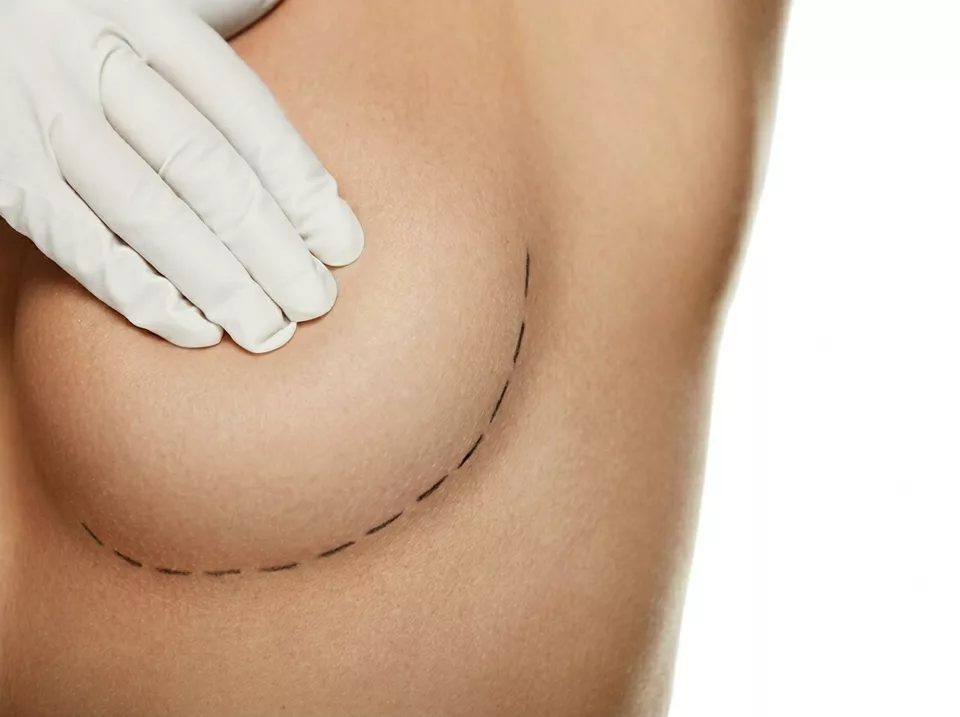
Breast lipofilling — also called breast fat grafting or fat transfer breast augmentation — uses the patient’s own purified fat to add modest volume to the breast without synthetic implants. It simultaneously reduces fat in the donor area through liposuction, combining body contouring with breast enhancement in a single procedure.
This guide covers breast-specific fat grafting in detail. For the full overview including facial and body applications, see the complete fat grafting guide.
Quick answer: Breast lipofilling transfers purified fat — harvested from the abdomen or flanks via liposuction — into the breast to add approximately one cup size of natural volume without implants. Around 50–70% of the transferred fat integrates permanently. It is suited to patients seeking modest, natural augmentation or symmetry correction who prefer to avoid synthetic materials.
Why Patients Choose Breast Lipofilling Over Implants
Breast lipofilling and implant-based augmentation have different clinical profiles and suit different patients.
| Breast Lipofilling | Implant-Based Augmentation | |
|---|---|---|
| Material | Patient’s own fat — no foreign body | Silicone or saline implant |
| Volume achievable | Modest (~1 cup size per session) | Larger increases possible |
| Feel | Natural — own tissue | Depends on implant type and placement |
| Scarring | Minimal (liposuction entry points + injection sites) | Incision at crease, areola, or axilla |
| Implant risks | None | Capsular contracture, implant rupture, replacement |
| Donor site benefit | Simultaneous slimming of donor area | None |
| Staged sessions | Possible for larger goals | Typically single procedure |
| Mammography | Distinguishable changes; inform radiologist | Implants alter mammogram; implant-displaced views required |
The appropriate choice depends on the degree of augmentation sought, body composition (available donor fat), skin envelope laxity, and individual priorities regarding natural feel vs. volume capacity.
How Breast Lipofilling Works
Step 1 — Fat Harvesting
Fat is removed from donor areas — typically the abdomen, flanks, lower back, inner thighs, or arms — using a gentle, low-pressure liposuction technique. For breast augmentation, the volumes required are larger than for facial applications: typically 300–500ml of harvested fat to yield 150–350ml of processed fat per breast.
Step 2 — Processing
The harvested fat is centrifuged or filtered to remove blood, oils, damaged cells, and fluids. Only purified, viable fat cells are prepared for reinjection. Some surgeons combine macro and micro fat for different layers of injection.
Step 3 — Injection
Purified fat is injected in small, precise aliquots throughout the breast tissue — subcutaneously, into the glandular layer, and in some cases prepectoral — in multiple passes and at multiple depths. This multi-plane, micro-injection technique maximizes the surface area contact between injected fat and surrounding vascularized tissue, which is essential for graft survival.
The procedure is performed under general anaesthesia.
How Much Augmentation Is Possible?
The achievable volume per session is limited by:
- Donor fat availability — the volume of fat that can safely be harvested from available donor sites
- Breast tissue capacity — the skin envelope and existing breast tissue can only accommodate a certain volume without compromising graft survival (overcrowding reduces vascularization)
- Graft survival rate — typically 50–70%; surgeons account for this by slightly over-injecting
In practice, one cup size per session is a typical realistic expectation. For patients seeking larger results, staged sessions (typically spaced 6+ months apart to allow full integration) can achieve a cumulative result.
Breast Lipofilling for Specific Indications
Breast Asymmetry Correction
Breast asymmetry — where one breast is noticeably larger or differently shaped than the other — is one of the most clinically effective applications of breast fat grafting. A precisely calculated volume of fat is transferred to the smaller side to improve symmetry. This is often more appropriate than placing asymmetric implants.
Post-Breastfeeding Volume Restoration
Volume loss following pregnancy and breastfeeding is a common concern. Breast lipofilling restores lost volume without implants, suited to patients who have completed their childbearing journey and are at a stable weight.
Post-Implant Removal Supplementation
Patients undergoing implant removal (explantation) who do not wish to replace implants may consider breast lipofilling to partially restore volume using their own fat. The achievable volume is limited compared to implants, and expectations are managed during consultation.
Combined with Mastopexy
Breast lipofilling can be combined with mastopexy (breast lift) when both repositioning and modest volume augmentation are desired. Dr. Kotti’s Chignon Mastopexy technique addresses the internal glandular architecture while fat grafting can supplement the upper pole. Combined planning is discussed during consultation.
Safety and Mammography Considerations
Breast fat grafting produces imaging changes (oil cysts, calcifications, areas of fat necrosis) that can appear on mammography. Current evidence and radiological guidance indicate these changes are distinguishable from malignant findings by experienced breast radiologists when they are aware of the prior fat grafting procedure.
Patients undergoing breast lipofilling should:
- Inform their radiologist and mammography technician of prior fat grafting at every future screening
- Continue regular mammography screening as recommended for their age and risk profile
All imaging considerations are discussed during the pre-operative consultation.
About Dr. Bouraoui Kotti — Breast Lipofilling in Dubai
Dr. Bouraoui Kotti is an EBOPRAS-certified plastic and reconstructive surgeon with over 20 years of experience in breast surgery — including breast lipofilling, mastopexy, and combined procedures — at Seline Clinic Dubai, UAE. He is the inventor of the Chignon Mastopexy, a published internal breast lift technique.
A pre-operative consultation includes anatomical assessment, discussion of achievable volume based on donor fat availability, planning of donor sites, full review of risks and imaging considerations, and individual cost breakdown.
Individual outcomes vary. A pre-operative consultation is mandatory.
Book a Free Consultation · See Before & After Results
Related procedures:
- Breast Lipofilling Dubai — Full procedure page with before/after results
- Breast Lift (Mastopexy) Dubai — Repositioning and reshaping without implants
- Breast Augmentation Dubai — Implant-based volume increase
Further reading:
- Chignon Mastopexy Dubai — Dr. Kotti’s published breast lift technique — how internal glandular flaps work
- Breast Lift Dubai — Complete Guide — 4 technique options, recovery, and comparison with augmentation
- Fat Grafting Dubai — Complete Guide — Full overview of lipofilling across face, breast, and body
- Fat Grafting Cost Dubai — What affects the price and what a complete quote should include
The information in this article is provided for patient education purposes only and does not constitute medical advice. Suitability for any procedure must be determined through an individual clinical evaluation with a licensed specialist.
Frequently Asked Questions
Can fat grafting replace breast implants?
Fat grafting to the breast can provide modest augmentation — typically one cup size — using the patient's own fat, without implants or synthetic material. It is suited to patients seeking natural augmentation, symmetry correction, or volume restoration. It is not equivalent to implant-based augmentation for patients seeking significant volume increase, as donor fat availability and graft survival limits the achievable volume. Suitability is assessed individually during consultation.
How much can breast fat grafting increase breast size?
Breast lipofilling typically achieves approximately one cup size increase per session. The limiting factors are the volume of donor fat available, the capacity of the breast tissue to accept fat without compromising graft survival, and the skin envelope to accommodate increased volume. Patients seeking larger increases may require staged sessions. The achievable outcome is assessed individually based on anatomy.
How long do breast fat grafting results last?
Approximately 50–70% of transferred fat integrates permanently with surrounding breast tissue. The integrated fat behaves like normal breast tissue and is considered long-lasting. Results may change with significant weight fluctuations. Final stable results are assessed at 3–6 months post-procedure.
Is breast fat grafting safe?
Breast lipofilling is considered safe when performed by a qualified surgeon following established protocols. Clinical concerns historically raised about fat necrosis or interference with mammography have been addressed by evidence showing that imaging findings following fat grafting are distinguishable from malignant changes by experienced radiologists. All clinical considerations and risks are discussed in full during the pre-operative consultation.
Can breast lipofilling be combined with a breast lift?
Yes. Breast lipofilling and mastopexy are sometimes combined: the lift repositions the breast tissue and nipple-areola complex, while fat grafting adds volume to the upper pole or addresses areas of loss. The combination is planned individually based on anatomy and goals. Read the Chignon Mastopexy guide for Dr. Kotti's published internal lift technique.
Who is a suitable candidate for breast fat grafting?
Suitable candidates are patients seeking modest augmentation without implants, correction of breast asymmetry, volume restoration after breastfeeding or weight loss, or supplementary volume enhancement alongside other breast procedures. Sufficient donor fat must be available. Patients with very low body fat or those seeking significant volume increase may be better suited to implant-based augmentation. Suitability is assessed during consultation.
Related Clinical Articles
BBL Dubai (Brazilian Butt Lift) — Results, Safety & Recovery
BBL in Dubai uses the patient's own fat — no implants. ~50–70% integrates permanently. Above-muscle protocol only. EBOPRAS-certified Dr. Kotti at Seline Clinic.
May 7, 2026

Nano Fat Grafting Dubai — Micro-Fat vs Nano-Fat Explained
Nano fat grafting in Dubai: ultra-fine fat emulsion injected into fine lines, under-eyes, and delicate areas. Different from standard lipofilling — technique explained by Dr. Kotti.
Jun 6, 2026