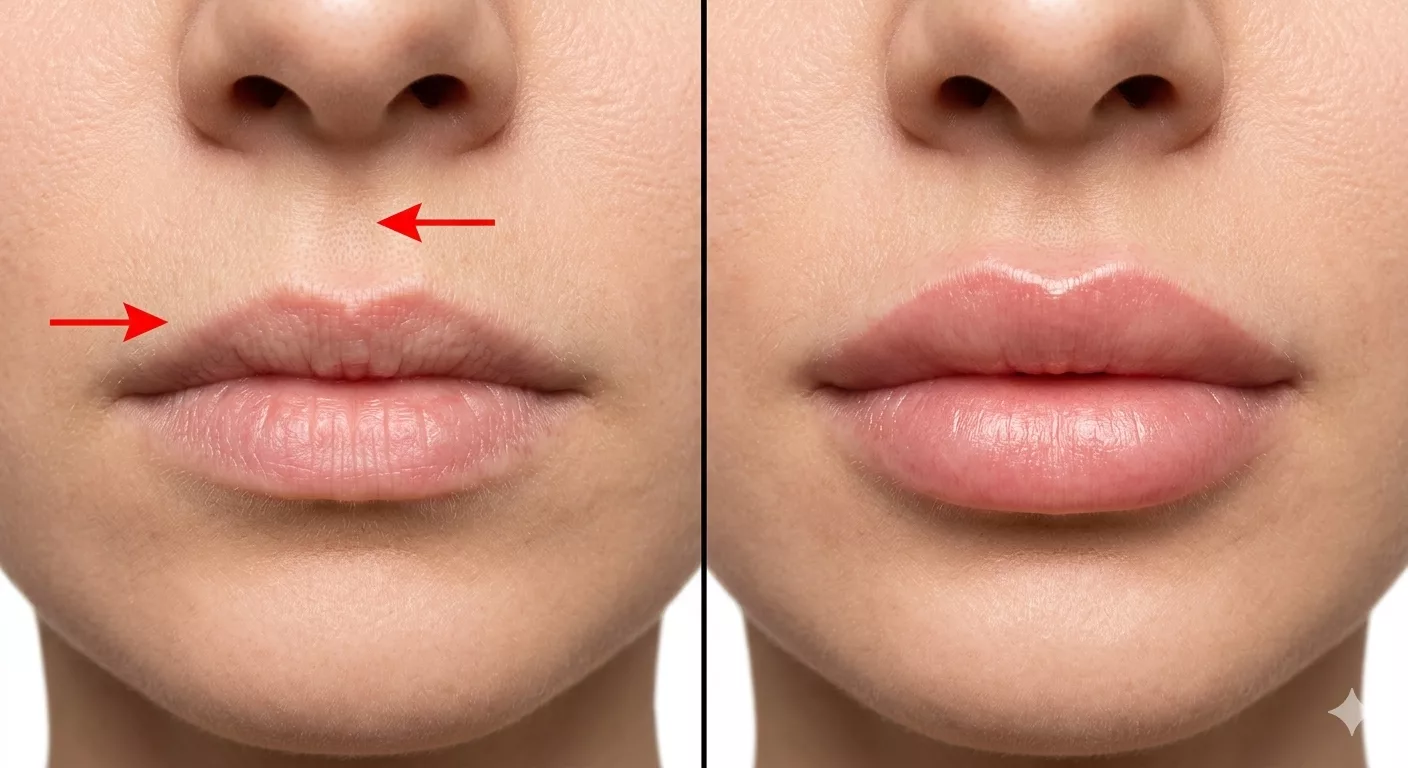
The lip is a central feature of facial harmony, and even a 2–3 mm difference in the philtrum — the space between the nose and upper lip — can shift the entire balance of the face. Whether the concern is a philtrum that has elongated with age, lips that are disproportionate to the lower face, or a subtle eversion effect without surgery, lip surgery in Dubai offers a precise solution for each.
This guide covers all four main options: Bullhorn lip lift, lip reduction, lip flip, and lipofilling — with clear criteria for choosing between them. For comprehensive facial rejuvenation options, explore our facial procedures section.
Quick answer: Lip surgery in Dubai covers permanent surgical corrections and temporary enhancements. A Bullhorn lip lift shortens the philtrum and exposes more upper lip vermilion — producing permanent results in 30–60 minutes under local anaesthesia. Lip reduction removes excess tissue with no visible scarring. The lip flip is a temporary botulinum toxin treatment for subtle eversion. Cost depends on technique and complexity, assessed at individual consultation.
What Is Lip Surgery? Procedures Available in Dubai
Lip surgery is not a single procedure — it is a category covering several distinct techniques addressing different anatomical goals:
| Procedure | Goal | Type | Duration |
|---|---|---|---|
| Bullhorn Lip Lift | Shorten philtrum, expose upper lip | Surgical | 30–60 min |
| Lip Reduction | Reduce excess lip volume | Surgical | 30–60 min |
| Lip Fillers | Add temporary volume | Non-surgical | 15–30 min |
| Lip Flip | Subtle upper lip eversion | Non-surgical | 10–15 min |
| Lipofilling (fat grafting) | Long-lasting volume restoration | Surgical | 60–90 min |
Surgical procedures are performed under local anaesthesia as outpatient treatments. Each option requires a different clinical indication — the correct procedure is identified during an individual anatomical assessment.
What Is a Lip Lift? The Bullhorn (Subnasal) Technique
The Bullhorn lip lift is the most commonly performed permanent lip enhancement procedure. It addresses the most common aesthetic complaint in lip surgery: a philtrum that is too long.
The philtrum elongates naturally with age — typically beginning in the mid-30s. As it lengthens, the upper lip rolls inward, reducing the visible pink tissue (vermilion) and creating a flat, thin appearance. This structural change cannot be corrected by fillers alone, because the problem is the length of the skin between the nose and lip — not the volume of the lip itself.
What a Bullhorn Lip Lift Achieves
- Shortens the philtrum — restores a more youthful distance between the nose and the upper lip border
- Exposes the vermilion — physically rotates the upper lip outward to reveal more pink tissue
- Improves the Cupid’s bow — enhances the natural arch definition of the upper lip
- Permanent results — unlike fillers or the lip flip, a surgical lift does not require maintenance treatments
The Bullhorn incision follows the natural curve of the nostrils — the excised skin strip is removed from the base of the nose, and the resulting scar sits in the nasal base shadow. As the scar matures over 3–6 months, it becomes near-invisible in the crease. The procedure is performed under local anaesthesia and takes 30–60 minutes.
Who Is a Candidate for a Lip Lift?
- Philtrum length of 15 mm or more (the general aesthetic threshold for surgical intervention)
- Upper lip thinning or inversion caused by philtrum elongation rather than volume loss
- Patients who want a permanent result without ongoing maintenance
- Adults who have completed facial growth
- Non-smokers or patients able to stop smoking for the perioperative period
Anatomical candidacy is assessed individually during consultation — the surgeon evaluates philtrum length, lip vermilion height, nasal base width, and overall facial thirds before recommending any technique. For patients concerned with nasal proportions alongside lip concerns, rhinoplasty may be considered in combination.
Corner Lip Lift: An Alternative for Downturned Lip Corners
A variation of the standard lip lift, the corner lip lift addresses the lateral corners of the mouth that turn downward — giving a sad or stern resting expression. Small triangular excisions at each corner elevate the mouth angles. It can be performed independently or in combination with the Bullhorn technique.
Lip Reduction Surgery Dubai
Lip reduction is indicated when one or both lips are disproportionately large relative to the facial structure — whether as a natural anatomical trait, the result of ethnicity-related lip volume, or overcorrected permanent filler treatments.
The procedure removes a precisely planned ellipse of mucosal tissue from the inner surface of the lip. The incision is entirely intraoral — there is no visible external scar. One or both lips may be treated in the same session. The technique is performed under local anaesthesia in 30–60 minutes.
Lip reduction surgery cost depends on whether one or both lips require treatment, the volume of tissue removed, and the complexity of the resection. Because anatomical variation between patients is significant, a cost is only provided after an individual clinical evaluation.
Recovery from Lip Reduction
- Days 1–3: Swelling peaks; soft diet recommended; mild discomfort managed with analgesics
- Days 3–5: Swelling decreases substantially; normal eating resumes progressively
- Week 1: Return to social activities and normal diet; no visible external changes during healing
- Final result visible at 6–8 weeks as residual swelling resolves
Non-Surgical Options: The Lip Flip
If you are not ready for a permanent surgical change, the lip flip is a popular temporary alternative for patients wanting subtle upper lip eversion.
How it works: A small amount of botulinum toxin is administered into the orbicularis oris muscle at the upper lip border. By partially relaxing the muscle, the lip border rolls slightly outward — creating the appearance of a more visible, fuller upper lip.
Key facts about the lip flip:
- Duration: 2–3 months; requires regular maintenance treatments
- No downtime; mild bruising at injection points may occur
- Does not shorten the philtrum — it is not a substitute for a lip lift
- Best suited to patients with minimal lip eversion who prefer a reversible outcome
Lip Fillers vs. Lipofilling
Hyaluronic acid fillers are the most common non-surgical lip enhancement: they add volume and last 6–18 months before gradual reabsorption. Lipofilling (fat grafting) is a surgical alternative — fat is harvested from another area of the body and injected into the lips for a longer-lasting result. Lipofilling is the more durable option for patients seeking volume restoration beyond what temporary fillers provide.
Surgical vs. Non-Surgical Comparison
| Procedure | Goal | Permanence | Recovery |
|---|---|---|---|
| Bullhorn Lip Lift | Shorten philtrum | Permanent | 1–2 weeks |
| Corner Lip Lift | Lift mouth corners | Permanent | 1–2 weeks |
| Lip Reduction | Reduce volume | Permanent | ~1 week |
| Lip Fillers | Add volume | 6–18 months | 1–3 days |
| Lip Flip | Subtle eversion | 2–3 months | Immediate |
| Lipofilling | Volume restoration | Long-lasting | 1–2 weeks |
Lip Lift Before and After: What to Expect
Patients researching lip lift before and after results should understand the typical visual progression:
Immediately post-procedure: The lip appears swollen and the philtrum shortening is exaggerated by oedema. This is expected and temporary.
Days 3–5: Swelling resolves significantly. Sutures remain in place. The patient typically remains at home during this phase.
Days 5–7: Suture removal. The lip begins to settle into its new position.
Week 2: Most patients are presentable for social and professional settings. The improvement in philtrum-to-lip proportion is visible — the upper lip sits higher, with more vermilion exposed.
Months 3–6: The subnasal scar continues to mature, fading into the natural shadow of the nasal base. The final result is considered stable at 6 months.
The most dramatic before-and-after improvement is visible in the profile view: the “S-curve” of the lip becomes more defined, and the overall facial balance shifts toward a more proportionate, youthful appearance.
Recovery After Lip Surgery in Dubai
Recovery from lip surgery is generally straightforward. Specific timelines depend on the procedure:
Bullhorn Lip Lift:
- Days 1–3: Swelling peaks; cold compresses recommended; limited facial animation
- Days 3–5: Swelling decreases substantially; sutures in place
- Days 5–7: Suture removal; mild social activities possible
- Week 2: Return to normal activities; the lip has largely settled
- Months 3–6: Scar matures; final proportional result visible
Lip Reduction:
- Days 1–3: Swelling and mild discomfort; soft diet
- Week 1: Normal diet and activities resume; no visible external scarring
Lip Flip:
- No recovery required; mild temporary bruising at injection sites may occur
Lip Surgery Cost in Dubai
The cost of lip surgery in Dubai depends on:
- The specific procedure — Bullhorn lip lift, corner lip lift, lip reduction, or non-surgical treatment
- The technique required and surgical complexity
- Whether one or both lips are treated
- Anaesthesia type and duration
- Facility standards and accreditation
- Whether the procedure is combined with other facial corrections
Online price ranges do not reflect individual anatomical complexity. A Bullhorn lip lift that takes 35 minutes in one patient may require 60 minutes in another, depending on philtrum anatomy and skin characteristics. An accurate cost assessment is provided only after an individual clinical evaluation.
Cost depends on the surgical technique required, the complexity of the individual case, and whether procedures are combined. An accurate estimate is only possible following an in-person consultation.
Which Country Is Best for Lip Surgery?
For patients based in the UAE and GCC, Dubai is the optimal destination for lip surgery. Key advantages:
- DHA regulation: Every surgeon must hold a valid DHA specialist licence; every facility must meet defined accreditation standards — providing legal accountability under UAE law
- EBOPRAS-certified Consultants: The clinic’s EBOPRAS-certified Consultant holds European Board of Plastic, Reconstructive and Aesthetic Surgery certification — one of the most rigorous plastic surgery qualifications internationally, covering facial procedures including lip lift surgery
- No post-operative travel: UAE and GCC patients do not need to travel abroad during the recovery window. Intercontinental flights within 1–2 weeks post-operatively carry complication risk
- Direct follow-up: Same operating surgeon for all post-operative appointments — no remote consultations, no communication barriers
Compared to Turkey — the most commonly searched alternative destination for lip surgery — Dubai offers uniform mandatory DHA regulation, direct post-operative access to your surgeon, and no recovery travel risk.
About the Surgeon
The EBOPRAS-certified Consultant plastic surgeon has over 20 years of international surgical experience across Europe, the USA, and the Middle East. They practise in Jumeirah, Dubai under current DHA licensing standards.
For facial procedures — including lip lift, rhinoplasty, facelift, and blepharoplasty — the clinical approach prioritises anatomical proportion: the goal is a natural result within the patient’s own facial structure, not a trend-driven appearance.
The surgeon is a member of EBOPRAS, ISAPS (International Society of Aesthetic Plastic Surgery), and ASPS (American Society of Plastic Surgeons). They are the inventor of the Chignon Mastopexy, published in Aesthetic Plastic Surgery (2018, PubMed).
Book a consultation for a personal clinical evaluation of lip surgery candidacy and technique options.
Related Procedures:
Medical Disclaimer: This information is for general educational purposes only. Individual results, recovery timelines, and candidacy depend on anatomy and medical history. A clinical consultation with a DHA-licensed EBOPRAS-certified surgeon is required before any procedure. Results are not guaranteed.
Frequently Asked Questions
Which country is best for lip surgery?
Dubai is one of the leading global destinations for lip surgery. DHA-regulated standards, EBOPRAS-certified Consultants, and accredited facilities make Dubai comparable to top centres in Europe and the USA. For patients in the UAE and GCC, Dubai eliminates post-operative travel risk while providing access to internationally board-certified surgeons.
How much is a lip lift?
The cost of a lip lift depends on the surgical technique (Bullhorn subnasal lip lift), the complexity of philtrum shortening required, anaesthesia, and facility standards. No responsible surgeon provides a price without first evaluating your anatomy. An accurate estimate requires an individual clinical consultation.
Is Dubai good for cosmetic surgery?
Yes. Dubai enforces strict medical regulation through the Dubai Health Authority (DHA). All surgeons must hold a valid DHA specialist licence and all facilities must meet defined accreditation standards. The concentration of EBOPRAS-certified and internationally board-certified Consultants makes Dubai one of the most regulated cosmetic surgery destinations globally.
How much would lip surgery cost?
Lip surgery cost depends on whether you are undergoing a surgical lip lift, lip reduction, or non-surgical lip flip — each has different anaesthesia requirements, surgical duration, and facility standards. A specific cost is only provided following individual clinical evaluation, as the same technique can vary significantly in complexity from patient to patient.
What is a Bullhorn lip lift?
The Bullhorn lip lift (subnasal lip lift) removes a small strip of skin at the base of the nose to shorten the philtrum and expose more of the upper lip vermilion. The incision follows the natural curve of the nostrils — resembling bullhorns — placing the scar in the nasal base shadow where it matures into near-invisibility over 3–6 months. Results are permanent.
How long is recovery after lip lift surgery?
Initial swelling resolves within 3–5 days. Sutures are removed after 5–7 days. Most patients return to social activities within 2 weeks. The subnasal scar continues to mature and fade over 3–6 months. Final results are considered stable at 6 months post-operatively.
What is a lip flip and how does it differ from a lip lift?
A lip flip uses botulinum toxin injected into the upper lip border muscle to allow the lip to roll slightly outward — creating the appearance of a fuller upper lip. It is temporary (2–3 months) and does not shorten the philtrum. A surgical lip lift is permanent and structurally corrects philtrum length. The two procedures address different anatomical goals.
What is lip reduction surgery?
Lip reduction removes excess mucosal tissue from one or both lips through an incision inside the mouth — leaving no visible external scar. It is indicated for naturally large lips or overcorrected permanent filler results. Recovery is approximately 1 week.
What is the difference between a lip lift and lip fillers?
A lip lift is a permanent surgical procedure that shortens the philtrum by removing skin at the nasal base. Lip fillers add temporary volume using hyaluronic acid (6–18 months) or fat grafting. They address different anatomical goals: lip lift corrects structural philtrum length; fillers correct volume loss. They are not interchangeable.
Can a lip lift be combined with other facial procedures?
Yes. A lip lift is frequently combined with rhinoplasty, facelift, blepharoplasty, or other facial procedures in a single session — reducing total recovery time. Whether combination is appropriate depends on individual anatomy and medical profile, assessed during consultation.
How long does a lip lift last?
A lip lift produces permanent results. Because it involves the physical removal of skin and repositioning of the lip — rather than injection of a temporary substance — the structural change does not reverse with time. Normal facial aging continues, but the shortened philtrum is a permanent anatomical change.
What is the ideal philtrum length for a lip lift?
The aesthetic threshold for lip lift intervention is generally considered a philtrum length of 15 mm or more, though this varies with facial proportions and ethnicity. The surgeon assesses philtrum length, lip volume, nasal base width, and overall facial thirds during consultation to determine whether a lip lift — and which technique — is anatomically appropriate.
Related Clinical Articles
Cosmetic Procedures Dubai | Trends, Costs & Advances
Discover the latest cosmetic procedures trends in Dubai for 2026: popular treatments, advanced techniques, recovery, costs, and what's new in aesthetic enhancements. Expert guide.
Apr 21, 2026
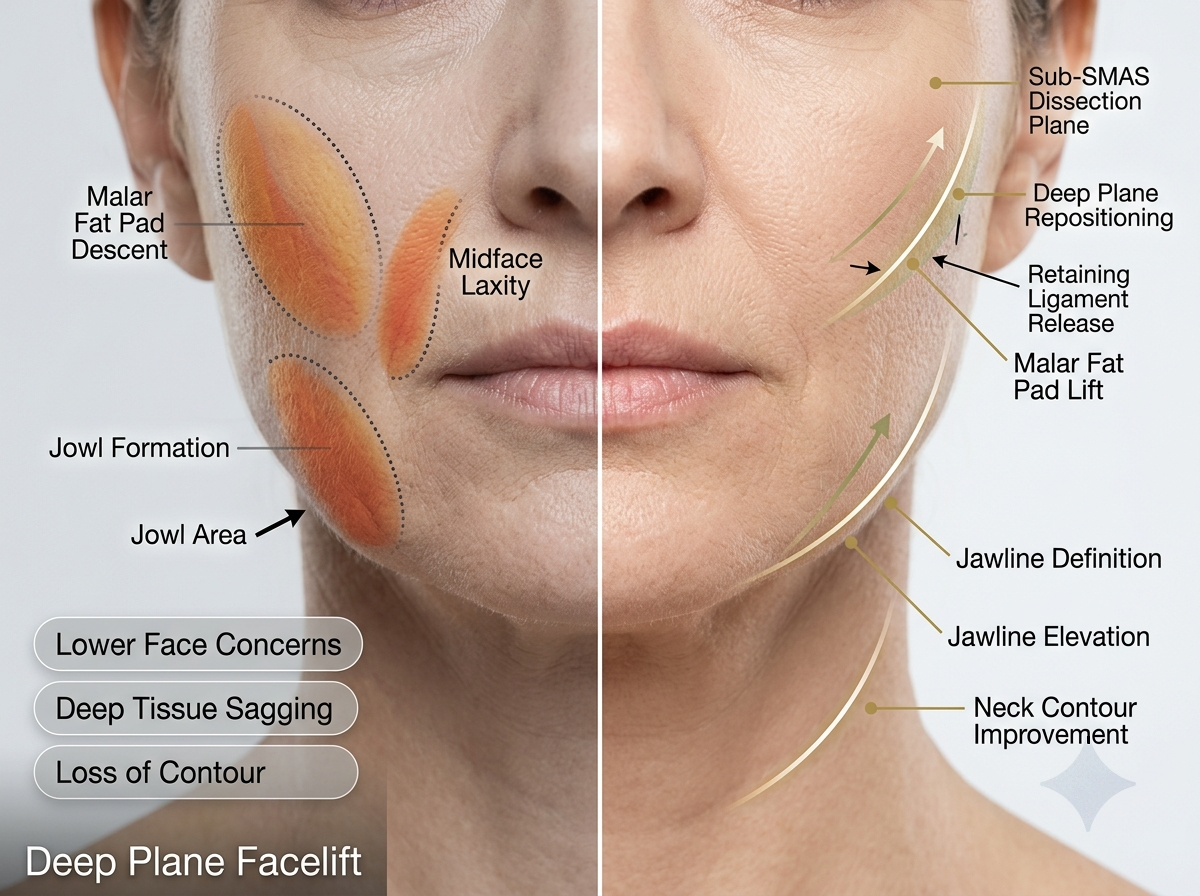
Deep Plane Facelift Technique | Surgical Anatomy Explained
Deep plane facelift technique explained: composite flap anatomy, retaining ligament release, and facial nerve safety in sub-SMAS dissection, for clinically informed readers.
Jul 7, 2026