

A British Mathematician “Alfred North Whitehead” once said: “Art is the imposing of a pattern on experience, and our aesthetic enjoyment is recognition of the pattern”. With this I would like to recognize Dr Kottis’ immense talent driven by his extensive experience and thank him for his courtesy and professionalism. You are a wonderful Plastic Surgeon, but above all else, a terrific human being. Thanks again for the excellent care.
Facial · Rhinoplasty · Dubai
Rhinoplasty in Dubai
Are you considering rhinoplasty in Dubai to enhance your appearance and confidence? Finding the right board-certified specialist is the most critical step in your journey. This guide covers what you need to know about the procedure, recovery, and what to expect from a premier aesthetic clinic in Dubai.
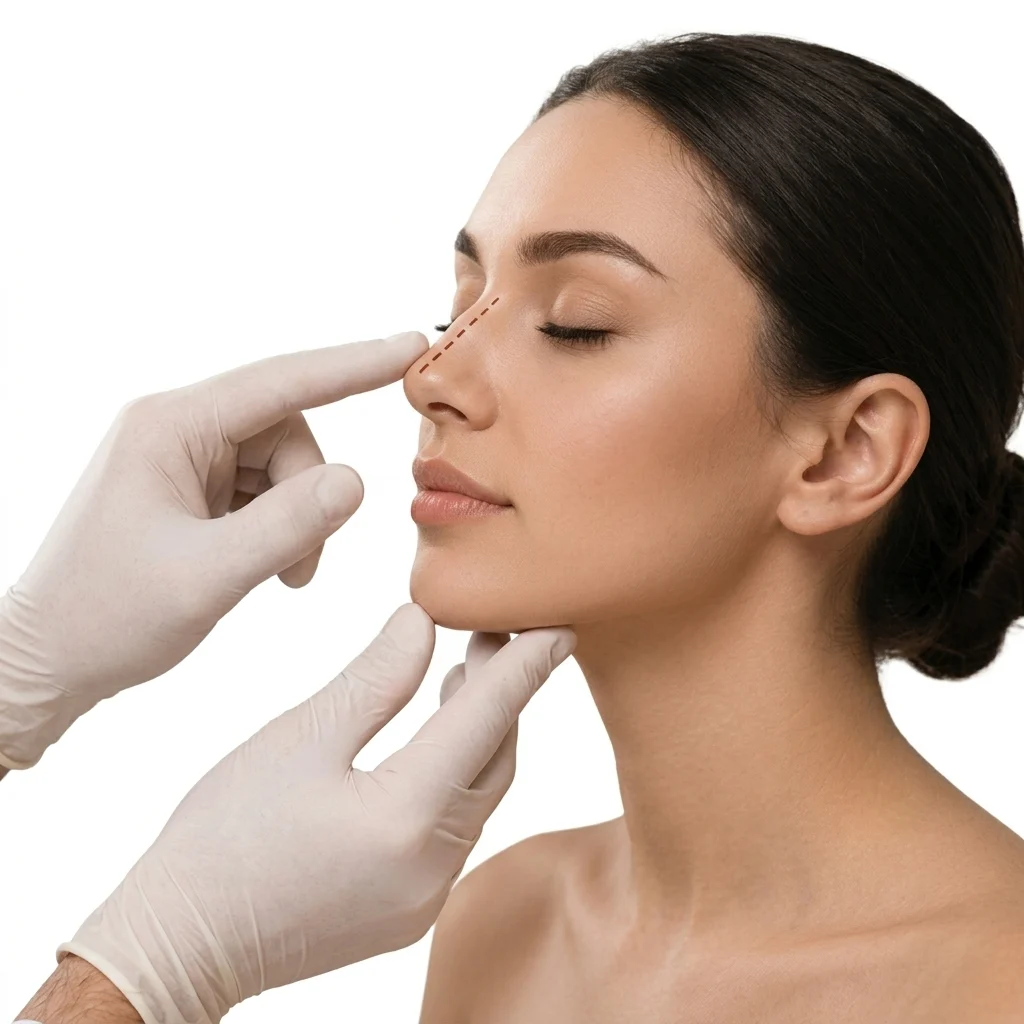
This illustration is for educational purposes only, intended to explain the surgical technique. Individual results and anatomical requirements vary per patient.
What is
Rhinoplasty?
Rhinoplasty reshapes the bridge, tip, and nostrils to improve facial harmony. Technique is selected based on anatomy, skin thickness, and goals — surgical or non-surgical.
Surgical Techniques
Open or closed rhinoplasty is selected based on the degree of structural change required, alongside specialised approaches — preservation, ultrasonic, ethnic, or septorhinoplasty — chosen individually at consultation.
Non-Surgical (Liquid Rhinoplasty)
Hyaluronic acid filler smooths a dorsal hump, lifts a drooping tip, or corrects minor asymmetries — no surgery, no downtime, reversible, lasting 6–18 months. Cannot reduce size or correct breathing.
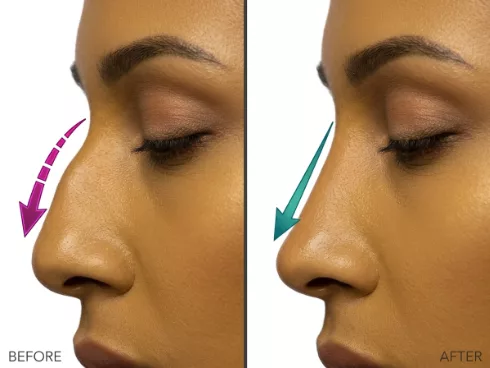
Rhinoplasty — Before & After
Photographs published with patient consent. The referenced procedure is the only visible change.
The Patient Journey: What to Expect
Rhinoplasty — Step by Step
From your first consultation to full recovery, here is what to expect at every stage.
- 01
Initial Consultation
A thorough physical assessment and treatment planning session to align your expectations with anatomical possibilities.
- 02
Pre-Operative Preparation
Customized instructions to ensure optimal health and safety before your procedure, based on your individual medical profile.
- 03
The Procedure
Performed under appropriate anesthesia in a state-of-the-art facility, with a focus on precision, safety, and natural-looking outcomes.
- 04
Recovery Phase
Dedicated post-operative care and follow-up appointments to monitor progress. Recovery timelines depend on individual anatomy and healing response.
EBOPRAS · MD PhD · 20 yrs
Our Rhinoplasty Surgeon in Dubai
Every procedure on this page is performed by Dr. Bouraoui Kotti — EBOPRAS-certified plastic surgeon, MD PhD, with over 20 years of international experience. Review his credentials, training, and clinical philosophy before your consultation.
View Dr. Kotti's Surgeon ProfileRhinoplasty — Frequently Asked Questions
What is the difference between open and closed rhinoplasty?
Open rhinoplasty places a small incision across the columella (the strip of skin between the nostrils) to give the surgeon direct visibility of the nasal structures — preferred for complex reshaping of the tip or significant structural corrections. Closed rhinoplasty keeps all incisions entirely inside the nostrils, leaving no external scar, and is well-suited for moderate dorsal reduction or tip refinement. The appropriate technique is determined by your anatomy and goals during the pre-operative consultation.
What is preservation rhinoplasty?
Preservation rhinoplasty is a newer approach that conserves rather than removes the natural tissue infrastructure of the nose — including the periosteum, perichondrium, and dorsal ligaments. Instead of breaking down the dorsum, the surgeon repositions the existing structures. This typically results in a more natural appearance over time, lower risk of revision, and softer-looking results compared to traditional reduction techniques. It is not suitable for every anatomy and is assessed individually during consultation.
What is nose reduction surgery (rhinoplasty for a large nose)?
Nose reduction surgery reduces the overall size or specific features of the nose — most commonly the dorsal hump (bridge bump), a wide or bulbous tip, or flared nostrils. The surgeon removes or reshapes excess cartilage and bone while maintaining structural integrity. Results are proportional to individual facial anatomy: the goal is balance, not a standard size. A clinical assessment determines what reduction is anatomically appropriate.
What is alarplasty?
Alarplasty reduces the width or flare of the nostrils (the alar base) when they are disproportionately wide relative to the rest of the nose or the face. A small wedge of tissue is removed from the base of each nostril, leaving a scar hidden in the natural crease. It is frequently combined with rhinoplasty but can also be performed as a standalone procedure for patients satisfied with their nose except for nostril width.
How long is rhinoplasty recovery in Dubai?
A nasal splint is typically worn for 7–10 days. Most patients are comfortable returning to work or daily life after 10–14 days, though visible swelling around the eyes and nasal bridge subsides over 3–4 weeks. The tip of the nose remains slightly swollen for several months — final shape becomes fully apparent at 9–12 months. Strenuous exercise is deferred for 4–6 weeks. A personalized post-operative protocol is provided during follow-up appointments.
How much does rhinoplasty cost in Dubai?
Rhinoplasty cost in Dubai depends on the technique required (open, closed, preservation), the complexity of the changes, whether functional correction (septoplasty) is combined, anaesthesia, and facility standards. An in-person clinical assessment is required for a personalized cost estimate. Cost is discussed transparently during consultation.
Can rhinoplasty improve breathing?
Yes. Septorhinoplasty combines cosmetic nose reshaping with functional correction of a deviated septum — the internal wall separating the two nostrils. When the septum is deviated, it restricts airflow through one or both nasal passages. The functional correction is performed through the same incisions as the cosmetic procedure, with no additional external scar. Functional and cosmetic goals are assessed together during consultation.
How do I choose a rhinoplasty surgeon in Dubai?
Key criteria include: board certification by a recognized plastic surgery body (EBOPRAS, ISAPS), specific experience in rhinoplasty rather than general cosmetic surgery, a consistent portfolio of before-and-after results reflecting your desired aesthetic, and a detailed pre-operative consultation process that discusses technique, anatomy, and realistic outcomes. Dr. Bouraoui Kotti is EBOPRAS-certified with 20+ years of rhinoplasty experience in Dubai.
What is ethnic rhinoplasty and who is it for?
Ethnic rhinoplasty is rhinoplasty performed with explicit attention to preserving the patient's racial and cultural nasal identity. It addresses specific anatomical characteristics common to Arabic, Persian, South Asian, Middle Eastern, or African-American noses — such as a low dorsal bridge, a wide alar base, a thick skin envelope, or a drooping tip — while maintaining facial harmony and ethnic character. It is not about Westernising features; it is about refining them within their natural context. Ethnic rhinoplasty is a regular part of clinical practice in Dubai given the region's diverse patient population.
What is ultrasonic rhinoplasty (piezo rhinoplasty) and is it available in Dubai?
Ultrasonic rhinoplasty uses a piezoelectric device to cut and sculpt nasal bone without the trauma of conventional surgical hammers and chisels. The ultrasonic tip operates selectively on mineralized tissue only, leaving soft tissue, blood vessels, and nerves intact. This translates to significantly less post-operative bruising and swelling, more precise bony dorsum reshaping, and a faster recovery compared to traditional osteotomy. Its suitability is assessed individually during the pre-operative consultation.
Can a nose job be done without surgery?
Yes — non-surgical rhinoplasty uses hyaluronic acid filler to visually smooth a dorsal hump, lift a drooping tip, or correct minor asymmetries without incisions or downtime. Results are immediate and reversible, lasting 6–18 months. The key limitation: filler adds volume — it cannot reduce nasal size, narrow a wide bridge, or address breathing issues. It suits patients with limited, specific concerns or those exploring changes before committing to surgical rhinoplasty.
What is the difference between surgical rhinoplasty and liquid rhinoplasty (nose filler)?
Surgical rhinoplasty permanently restructures nasal bone, cartilage, and soft tissue — it can reduce size, correct breathing, reshape the tip and bridge, and address significant structural changes. Liquid rhinoplasty (filler) is reversible, involves no downtime, and lasts 6–18 months — but only adds volume and cannot reduce the nose or correct function. Some patients use filler to preview changes before surgery; others find it sufficient for their goals.
Related Procedures in Dubai
Other Facial Procedures in Dubai
Verified Patient Reviews · Google 4.9★ · 200+ Authentic Stories
Patient Experiences in Dubai — Plastic & Aesthetic Surgery Published with Written Consent.
The following reviews are published with documented written patient consent.
MD PHD EBOPRAS* Certified Plastic Surgeon
Dubai, UAE
Specialist Plastic Surgeon · EBOPRAS Certified · Dubai UAE
Rhinoplasty in Dubai
Individual Assessment · Natural Results.
Dr. Bouraoui Kotti is a Specialist Plastic Surgeon (EBOPRAS-certified) with over 20 years of clinical experience, providing aesthetic and reconstructive surgery based on international standards.
