
Breast Lift vs Implants: Do You Need a Lift, Implants or Both?

Quick answer: The choice between a breast lift vs implants depends on what needs to change. A lift repositions and reshapes existing breast tissue; an implant adds volume and projection. If the breast has both loss of volume and significant sagging, an augmentation mastopexy may combine the two. Neither a photograph nor a requested cup size can determine the correct operation without examination.
People comparing breast implants or a lift are often trying to solve different concerns with one decision. A breast may feel empty after pregnancy or weight change, sit lower than before, have a low nipple position, or show several of these changes together. Each finding affects the surgical plan differently.
This guide owns the comparison question. For procedure-specific planning, review the dedicated pages for breast augmentation in Dubai and breast lift surgery in Dubai.
Breast Lift vs Implants: What Does Each Operation Change?
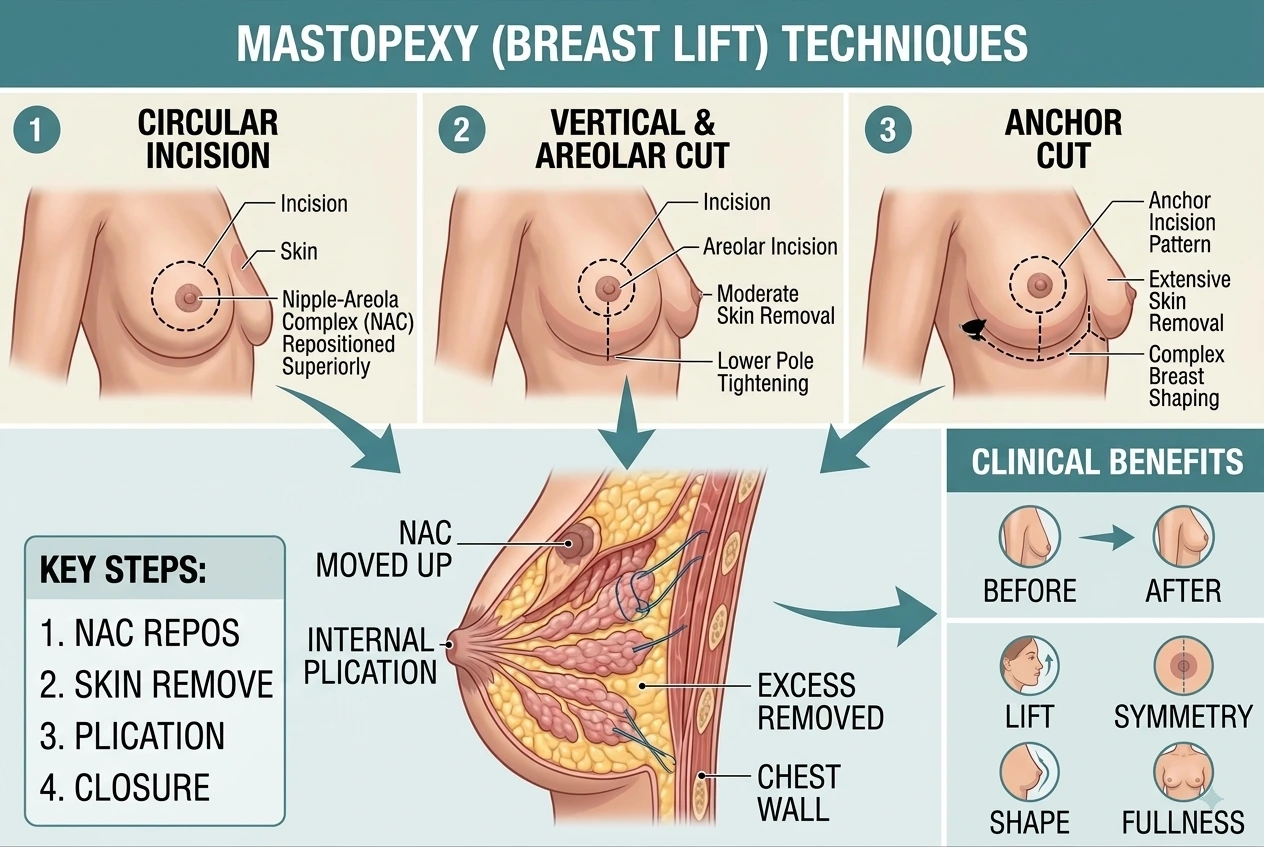
A breast lift, medically called mastopexy, removes selected excess skin, reshapes the existing tissue and repositions the nipple-areola complex when indicated. It primarily changes position and the skin envelope. It does not automatically add volume.
Breast implants add a medical device with selected width, projection and volume. Augmentation can restore fullness or enlarge the breast, but it does not remove substantial loose skin or reliably raise a nipple that sits too low.
| Concern | Breast lift | Breast implants | Lift with implants |
|---|---|---|---|
| Low nipple or substantial sagging | Primary treatment goal | Usually insufficient alone | May address position and volume |
| Adequate volume but low position | Often considered | May add unwanted volume | Usually unnecessary unless more volume is wanted |
| Low volume with suitable nipple position | Does not add an implant | Often considered | Lift may not be required |
| Low volume and excess skin | May improve position but not add implant volume | May not correct the skin envelope | May be considered after individual assessment |
| Scars | Around the areola, vertical and/or fold depending on pattern | Usually one access incision per breast | Includes lift scars plus implant access planning |
| Long-term considerations | Breast shape continues to age | Device monitoring and possible future surgery | Both tissue ageing and implant follow-up |
The table is a framework, not a self-diagnosis. Breast fold position, skin quality, tissue thickness, asymmetry, previous surgery and the desired change must be assessed together.
Can You Have Breast Implants Without a Lift?
Yes. Breast implants without a lift may suit selected patients whose nipple position and skin envelope remain appropriate and whose main concern is volume. Mild relaxation can sometimes be filled by a carefully sized implant, but adding an implant is not the same as lifting the breast.
An implant alone may be a poor match when:
- the nipple sits clearly below the breast fold;
- there is substantial loose or stretched skin;
- the nipple points downward;
- the lower breast rests heavily on the chest;
- a large implant would be needed mainly to fill an oversized skin envelope; or
- existing asymmetry requires tissue reshaping rather than volume alone.
Choosing a larger implant to avoid lift scars can create a different tradeoff: more device weight and tension on already stretched tissue. The safest plan is not determined by a desire to avoid one scar at any cost.
Can You Have a Breast Lift Without Implants?
Yes. A breast lift without implants may suit someone who has enough natural tissue and accepts their current breast volume but wants a higher position, a reshaped envelope or correction of a low areola.
A lift can redistribute existing tissue, but it cannot promise the same upper-pole fullness or projection as an implant. Some patients feel smaller after a lift because excess skin is removed and the breast becomes more compact even when little or no breast tissue is removed.
Patients considering lift patterns and their scars can read the detailed mastopexy techniques guide.
When Is a Breast Lift with Implants Considered?
A breast lift with implants, or augmentation mastopexy, may be considered when two separate objectives are present:
- reposition or reshape a breast affected by excess skin or a low nipple; and
- add volume or projection that the existing tissue cannot provide.
The operation is more complex than simply adding the steps of a lift and augmentation. The lift reduces and tightens the skin envelope, while the implant expands it and adds weight. Implant dimensions, tissue coverage, incision pattern, blood supply and the amount of repositioning must therefore be planned as one system.
Some patients can have both procedures in one operation. Others may be advised to stage treatment—for example, performing the lift first and assessing the healed shape before later augmentation. Staging means two operations and recoveries, but it may offer more control in selected complex, revision or higher-risk cases.
How Do Nipple Position and the Breast Fold Affect the Choice?
Nipple position is assessed in relation to the fold beneath the breast, but one measurement does not make the decision. The surgeon also reviews the direction of the nipple, the amount of skin below it, the distribution of breast tissue, fold stability and differences between the two sides.
Online “pencil tests” and photographs cannot evaluate tissue quality, three-dimensional shape or blood supply. They may encourage useful questions, but they cannot establish whether implants, a lift or a combined plan is appropriate.
Do Teardrop or Round Implants Change Whether a Lift Is Needed?
Implant shape does not remove excess skin or reposition a substantially low nipple. A teardrop implant distributes volume differently from a round implant, but neither shape replaces an indicated lift.
Device selection occurs only after defining the operation and the breast footprint. The teardrop breast implants guide compares anatomical and round implants, including rotation, surface and safety considerations.
Can Fat Transfer Replace Implants or a Lift?
Fat transfer can add modest volume or refine selected contours without placing an implant. It does not provide the same fixed projection as an implant, and it does not remove substantial skin or reproduce a mastopexy.
In selected cases, fat grafting may complement a lift or soften implant coverage. Donor-fat availability, tissue capacity and partial graft resorption limit the achievable change. It is still surgery and carries risks including fat necrosis, oil cysts, calcification, infection and asymmetry.
Breast Lift vs Implants: Scars and Recovery
Implant augmentation generally uses an incision in the breast fold, around part of the areola or, in selected cases, the armpit. A lift requires a pattern matched to the amount of skin and tissue repositioning: around the areola, around the areola plus a vertical scar, or an anchor pattern extending along the fold.
A combined procedure includes the lift scar pattern and implant-pocket planning. Swelling, bruising, tightness and temporary changes in sensation may occur. Driving, work, lifting, exercise, garment use and sleeping position should follow the operating surgeon’s written instructions rather than a generic online schedule.
Scars mature over months and vary with skin, tension, healing, nicotine exposure and complications. Shorter scars are not automatically the better operation if they cannot safely achieve the required reshaping.
How Should Before-and-After Photos Be Compared?
Breast lift and implant photographs are most informative when they show consistent front, oblique and side views, comparable lighting and the postoperative date. Check the starting nipple position, breast width, asymmetry and skin envelope—not only the final cup size.
Confirm whether the case involved a lift alone, implants alone, augmentation mastopexy, fat grafting or another procedure. A result from different anatomy cannot predict an individual outcome.
Safety Questions Before Choosing Implants
Breast implants are not lifetime devices. The FDA advises patients to review device-specific labeling and the patient decision checklist, understand that complications and additional operations can occur, and follow recommendations for long-term monitoring. Risks include capsular contracture, rupture or deflation, pain, sensation changes, asymmetry, infection and implant-associated malignancies.
Surface, fill, manufacturer, model, dimensions and current local availability should be discussed separately. Implant shape alone does not establish safety. Review the FDA overview of breast implants and its implant risks and complications guidance before consent.
A lift without implants avoids device-specific risks but remains surgery. Possible risks include bleeding, infection, delayed healing, scars, asymmetry, altered nipple or breast sensation, tissue loss and revision surgery. Combining procedures brings considerations from both operations.
What Affects Breast Lift vs Implant Cost in Dubai?
There is no single interchangeable price because the three possible plans have different scopes. Cost can depend on anatomical complexity, implant model when used, lift pattern, operating time, anaesthesia, licensed surgical facility, garments, medicines, follow-up and whether treatment is combined or staged.
Compare written quotations only after each surgeon has defined the intended operation and what the fee includes. A low advertised package may not represent the same device, facility, anaesthesia or aftercare.
Questions to Ask During a Breast Surgery Consultation
Use the consultation to clarify the decision rather than request a procedure by name:
- Is my main concern breast position, volume, skin excess or a combination?
- Where is the nipple relative to the fold, and why does that matter in my case?
- What can a lift achieve without an implant?
- What would an implant alone leave untreated?
- If both are proposed, why is one-stage or staged surgery more appropriate?
- Which scars and implant pocket would be required?
- What are the operation-specific risks and realistic limitations?
- How will implant monitoring and possible future surgery be handled?
The correct choice is the smallest appropriate plan that addresses the diagnosed anatomy and the patient’s informed goals. Suitability, technique and expected outcome require an individual clinical examination.
Sources and Further Reading
- FDA: What to Know About Breast Implants
- FDA: Things to Consider Before Getting Breast Implants
- FDA: Risks and Complications of Breast Implants
- American Society of Plastic Surgeons: Combining a Breast Lift with Implants
This article provides general education and does not replace medical advice. Surgical procedures carry risks, results vary between individuals and consultation is required.
Frequently Asked Questions
What is the main difference between a breast lift and implants?
A breast lift reshapes and repositions existing breast tissue and removes selected excess skin. An implant adds volume and projection but does not reliably correct substantial loose skin or a low nipple position. The appropriate operation depends on whether the main concern is position, volume or both.
Can you have breast implants without a lift?
Yes, selected patients can have implants without a lift when the nipple position and skin envelope are suitable and the main goal is additional volume. An implant alone may not correct significant sagging and can add weight to stretched tissue. Examination is required to assess the breast fold, nipple position, skin and tissue coverage.
Can you have a breast lift without implants?
Yes. A breast lift can reposition the nipple and reshape existing tissue without adding an implant. It may suit someone who accepts their current volume but wants improved position or shape. A lift does not guarantee increased upper-pole fullness or a larger breast size.
When are a breast lift and implants combined?
A combined augmentation mastopexy may be considered when the breast needs both repositioning and additional volume. Combining procedures increases planning complexity because the lift tightens the skin envelope while the implant adds volume and tension. Some cases may be safer or more predictable when staged.
Will implants alone lift sagging breasts?
Implants can fill selected mild relaxation, but they do not perform a true breast lift. If the nipple is low relative to the breast fold or there is substantial excess skin, an implant alone may leave sagging untreated or make it more noticeable.
Which operation leaves more scars?
Implant augmentation usually uses one access incision per breast. A lift requires scars around the areola and sometimes vertically to the fold or along the fold, depending on the amount and pattern of reshaping. Scar quality and visibility vary with technique, skin and healing.
Is recovery longer for a lift with implants?
Recovery depends on the surgical scope, implant pocket, lift pattern, health and individual healing. A combined procedure generally involves more tissue work than either operation alone, but personalized activity restrictions and follow-up are more useful than one universal timeline.
What affects breast lift versus implant cost in Dubai?
Cost depends on the operation, anatomical complexity, implant device when used, operating time, anaesthesia, licensed facility, aftercare and whether procedures are combined or staged. A responsible written quotation follows examination and a defined surgical plan.
Popular Procedures
Specialties
Related Clinical Articles

Breast Augmentation Dubai: Bilateral Surgery Explained
Breast augmentation treats both breasts with implants or fat transfer. Learn options and risks with Dr. Bouraoui Kotti in Dubai for an individual assessment.
Sep 12, 2026
Mastopexy Breast Lift: Techniques, Cost & Implant Options
Compare mastopexy techniques, anchor and donut lifts, breast lift cost, lifts without implants, small-breast options, fat transfer, scars and recovery.
May 15, 2026
