
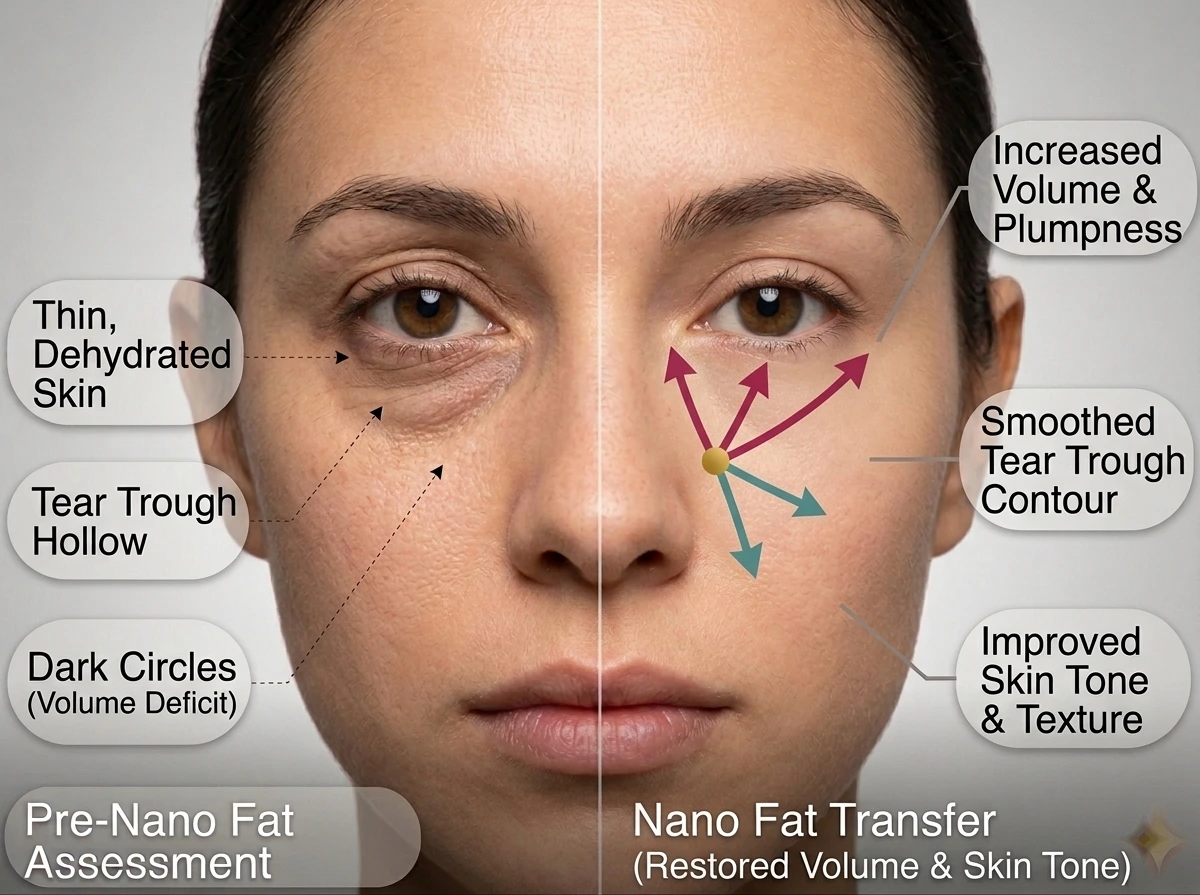
Nano Fat Grafting and Nano Fat Transfer Under Eyes
Quick Answer: Nano fat under the eyes addresses selected skin-quality concerns; it is not intended to restore substantial volume. Micro fat may be considered for selected tear-trough volume loss. They have different purposes and risks; suitability depends on eyelid anatomy and medical history. EBOPRAS-certified Consultant Plastic Surgeon Dr. Bouraoui Kotti assesses patients at Plastic & Cosmetic Surgery Clinic Dubai UAE.
Nano fat grafting is a refinement of standard fat grafting technique in which harvested fat is mechanically processed into an ultra-fine biological emulsion — small enough to be injected through very thin needles into delicate facial areas where standard fat transfer is not suitable.
This guide explains what differentiates nano fat from standard and micro fat grafting, where it is used, and how to evaluate whether it may be appropriate for your goals.
Nano fat is a finely processed fat preparation used for selected superficial skin-quality goals, not dependable volume restoration. It differs from micro fat, which retains small parcels intended for selected volume transfer. Composition and effects vary by processing and patient; neither technique is suitable for every under-eye concern.
What Is Nano Fat Grafting?
Standard fat grafting transfers whole, intact fat cells (adipocytes) to add volume to the face, breast, or body. The fat parcels are typically processed to 2.4–4mm size and injected through appropriately sized cannulas.
Nano fat is processed more extensively than volume-transfer fat. Preparation methods vary; the treating surgeon should explain the specific process and intended use. It is not a standardized cell-therapy product.
Nano fat is discussed mainly for selected superficial skin-quality goals rather than substantial volume addition. Evidence and outcomes vary, so a consultation should cover uncertainties and alternatives.
What Is Micro Fat Transfer?
Micro fat transfer, also called micro fat grafting or microfat grafting, uses small parcels of the patient’s harvested fat to restore selected volume. The preparation retains viable fat cells and is placed in an anatomical tissue plane appropriate to the treatment goal. Nano fat is processed more extensively and is used mainly for superficial skin-quality objectives rather than dependable structural volume.
The terms are sometimes used loosely, so the consultation should establish which preparation is proposed, where it will be placed and whether the objective is volume restoration, skin-quality improvement or a combination.
Micro Fat vs. Nano Fat: Key Differences
| Standard / Micro Fat | Nano Fat | |
|---|---|---|
| Processing | Centrifugation or filtering; intact parcels | Mechanical emulsification; cells disrupted |
| Delivery instrument | Selected according to parcel size and target plane | Selected according to preparation and target area |
| Proposed use | Selected volume-restoration goals | Selected superficial skin-quality concerns |
| Depth of injection | Deep fat compartments, subcutaneous | Superficial dermis, intradermal |
| Best applications | Cheeks, temples, lips (volume), tear trough (volume) | Fine lines, under-eye skin, lip borders, skin texture |
| Expected change | Variable retention; no result is guaranteed | Skin-quality effect is uncertain and varies |
| Changes in appearance | Timing and retained volume vary | Timing and extent of any change vary |
Micro fat and nano fat may be discussed together in selected cases to address different goals. Combination is not automatic, and the clinician should explain the rationale, evidence, risks and alternatives.
The terms micro fat grafting and microfat grafting describe the same small-parcel volume-restoration technique. Nano fat transfer, nanofat transfer and nano fat injection refer to the finer emulsified preparation used mainly for superficial skin-quality goals.
Unsure whether the concern is skin quality or volume?
A facial assessment can distinguish under-eye hollowing from skin or eyelid concerns and discuss suitable options.
Discuss under-eye options with Dr. Kotti
Clinical Applications of Nano Fat Grafting
Micro Fat Grafting Under Eyes and Tear-Trough Treatment
Micro fat grafting under eyes may be considered when selected tear-trough volume loss is the main concern. Micro fat transfer is intended to restore volume, whereas nano fat has a more superficial skin-quality role. The tear trough is anatomically delicate: the skin is thin, the underlying anatomy is complex, and any injectable or fat-transfer plan carries risks if the diagnosis, preparation or placement is inappropriate.
When protruding eyelid fat or selected skin excess is the main concern, read about lower eyelid plastic surgery, including its techniques, cost factors and recovery. An examination distinguishes bags from hollowing before treatment is chosen.
Some treatment plans combine carefully placed micro fat for volume with a finer preparation for superficial tissue quality. This is not a standard package, and neither technique is appropriate for every hollow, eyelid bag, pigmentation concern or skin-laxity pattern. Examination is required to distinguish these findings and discuss irregularity, swelling, asymmetry, vascular injury and other procedure-specific risks.
Nano Fat Grafting Under Eyes: What It Can and Cannot Do
Nano fat grafting under eyes may be considered when the goal is to address selected fine-line or skin-quality concerns in the thin periorbital area. Nano fat is processed into a fine emulsion and is not intended to provide reliable, substantial volume. For a pronounced tear-trough hollow, a clinician may assess whether micro fat transfer or another option is more appropriate. The choice depends on the cause of the concern, eyelid anatomy, skin condition and individual risk profile; assessment by a qualified surgeon is essential.
Nano Fat Transfer Under Eyes Cost
The cost depends on the surgical technique required, the complexity of the individual case, anaesthesia, facility standards, and whether procedures are combined. An accurate assessment requires an individual clinical evaluation.
Fine Lines and Skin Texture
Nano fat may be discussed for selected superficial skin-quality concerns. Evidence and effects vary; it should not be presented as a guaranteed way to stimulate collagen or improve texture. Areas raised for assessment may include:
- Periorbital lines (crow’s feet)
- Upper lip lines (perioral area)
- Forehead lines
- Neck and décolletage
Lip Border Definition
The vermilion border (lip outline) can be refined with nano fat to add soft definition without the stiffness that can occur with some fillers in this area.
Combined with Standard Fat Grafting
Nano fat and standard lipofilling have different proposed uses. A combined plan is considered individually rather than assumed to improve outcomes.
The Nano Fat Procedure: What to Expect
Nano fat grafting uses the same donor-site process as standard fat grafting — fat is harvested via gentle liposuction from a donor area (typically abdomen, inner thigh, or flanks). The volume harvested is smaller than for body fat grafting, as only a small quantity is needed for facial nano fat application.
After harvesting, the fat undergoes a mechanical emulsification process — filtered and emulsified until it becomes a homogeneous, injectable suspension. It is then injected into the target areas using fine needles under local anaesthesia or sedation, depending on the scope of the procedure.
Aftercare: Bruising, swelling and donor-site symptoms may occur. Follow the individual postoperative instructions and ask the clinical team about activity, wound care and symptoms that need review.
How Does Nano Fat Compare with PRP?
Nano fat and PRP are different approaches proposed for selected skin-quality concerns. Their materials, evidence and risks differ.
| Nano Fat | PRP | |
|---|---|---|
| Source | Processed adipose tissue; preparation varies | Blood-derived preparation; method varies |
| Volume needed | Small fat harvest required (liposuction) | Blood draw only — no liposuction |
| Combined use | Can be combined with micro fat in same session | Often combined with needling or injections |
| Potential effect | Proposed skin-quality use; outcome varies | Proposed skin-quality use; outcome varies |
Evidence, suitability and risks depend on the proposed method and individual circumstances; discuss them with a qualified clinician.
What Should You Clarify Before a Nano Fat Procedure?
- State whether the concern is under-eye skin quality, hollowing, pigmentation or another issue.
- Ask which preparation and tissue plane are proposed and why they fit the concern.
- Discuss evidence, risks, alternatives and the possibility of no treatment.
- Review aftercare and follow-up without relying on a promised result or fixed timeline.
Who Is a Suitable Candidate?
Nano fat grafting may be appropriate for patients who:
- Have selected skin-quality concerns rather than a goal of significant volume restoration
- Have concerns in delicate areas (under-eyes, fine lines) where standard fat grafting is not ideal
- Prefer autologous (own tissue) options over synthetic injectables
- Have adequate donor fat for harvesting (even a small amount is typically sufficient for facial application)
- Are in good general health with realistic expectations
Individual suitability is assessed during a pre-operative consultation that includes anatomical evaluation and discussion of goals.
About the Surgeon
Dr. Bouraoui Kotti is an EBOPRAS-certified Consultant Plastic Surgeon with over 20 years of experience in fat grafting techniques, including standard lipofilling, micro fat and nano fat applications.
Individual outcomes vary. A pre-operative consultation is mandatory.
Book a Consultation · See Before & After Results
Related procedures:
- Fat Grafting & Lipofilling — Full procedure details for body and face
- Facial Lipofilling — Dedicated facial fat transfer page
Further reading:
- Fat Grafting — Complete Guide — Full overview of lipofilling: technique, applications, retention rates
- Brazilian Butt Lift — The high-volume fat transfer application for gluteal augmentation
- Cosmetic Surgery Dubai — Overview of all procedures and what to look for in a surgeon
The information in this article is provided for patient education purposes only and does not constitute medical advice. Suitability for any procedure must be determined through an individual clinical evaluation with a licensed Consultant.
Frequently Asked Questions
What is nano fat grafting?
Nano fat is a preparation made by processing harvested fat more extensively than volume-transfer fat. It is discussed for selected superficial skin-quality concerns, not dependable volume restoration. Methods and composition vary, so ask the clinician to explain the specific preparation, proposed effects, evidence, risks and alternatives.
What is micro fat transfer, and how does it differ from nano fat?
Micro fat transfer, also called micro fat grafting or microfat grafting, uses small parcels that retain viable fat cells and are intended to restore selected volume. Nano fat is emulsified more extensively and is used mainly for superficial skin-quality goals rather than structural volume. The two preparations may be combined when clinically appropriate.
Can micro fat grafting be used under the eyes?
Micro fat grafting under the eyes may be considered for selected tear-trough volume loss, but thin eyelid tissues and complex vascular anatomy require careful assessment and precise placement. Nano fat has a different, more superficial skin-quality role. Neither technique is suitable for every under-eye concern.
Can nano fat grafting treat under-eye hollows?
Nano fat grafting is not a dependable way to restore significant under-eye volume. It may be considered for selected skin-quality concerns, while micro fat transfer may be discussed for carefully selected tear-trough volume loss. Thin eyelid skin and complex anatomy require an individual examination; neither approach suits every hollow or under-eye concern.
Is nano fat the same as stem cell therapy?
No. Nano fat is processed adipose tissue, not a standardized stem-cell therapy. Its composition depends on the processing method, and proposed skin-quality effects should not be described as guaranteed regeneration or as an approved cell-treatment product. Ask the clinician to explain the preparation, evidence, alternatives and uncertainties.
How long does nano fat grafting last?
The extent and duration of any skin-quality change vary by patient and technique. Nano fat is not intended to provide dependable volume restoration, and no duration can be guaranteed. Dr. Bouraoui Kotti can discuss the evidence, limitations, follow-up and whether another option better fits the individual concern.
Is nano fat grafting safe?
Nano fat grafting is a procedure with risks that depend on the donor and treatment areas, technique and individual health. Bruising, swelling, infection, asymmetry or irregularity may occur; delicate areas such as the under-eye need particular assessment. A surgeon should explain specific risks, alternatives and follow-up before consent.
What is the difference between nano fat grafting and dermal fillers?
Dermal fillers are injectable products; some hyaluronic-acid fillers may be dissolved by a qualified clinician. Nano fat is processed tissue transferred through a procedure and is not intended to provide dependable volume. Their proposed uses, risks, reversibility and evidence differ. The appropriate option depends on the concern, anatomy and individual assessment.
How many nano fat grafting sessions are needed?
There is no universal number of sessions. The decision depends on the concern, treatment plan, response and clinical review. A further session should not be assumed in advance; the surgeon can discuss whether it is appropriate after assessing the individual result and risks.
Can nano fat grafting be combined with surgical procedures?
Nano fat may be discussed alongside other procedures in selected cases, but combined treatment changes the plan and may affect risks and recovery. The surgeon should explain the reason for combining treatments, the additional considerations and alternatives before consent.
Is nano fat grafting painful?
Anaesthesia depends on the planned procedure and individual clinical profile. Discomfort, bruising or swelling may occur at the donor and treatment sites. Discuss pain management, aftercare and symptoms requiring medical review with the treating surgeon.
Popular Procedures
Specialties
Related Clinical Articles
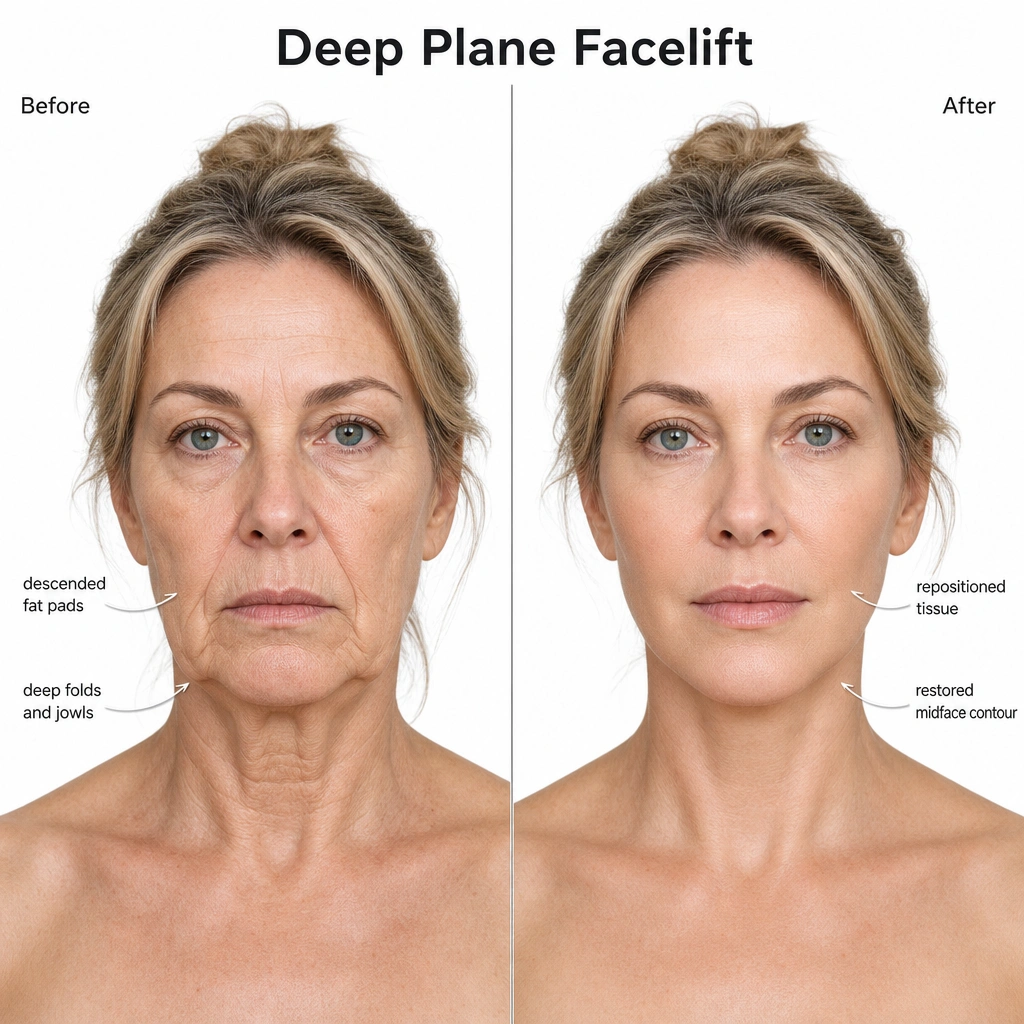
Deep Plane Face Lifting: Technique & Recovery | Dr. Kotti
Explore deep plane face lifting with Dr. Kotti's guide to surgical anatomy, SMAS comparisons, recovery, scars, risks and facelift cost considerations in Dubai.
Jul 7, 2026
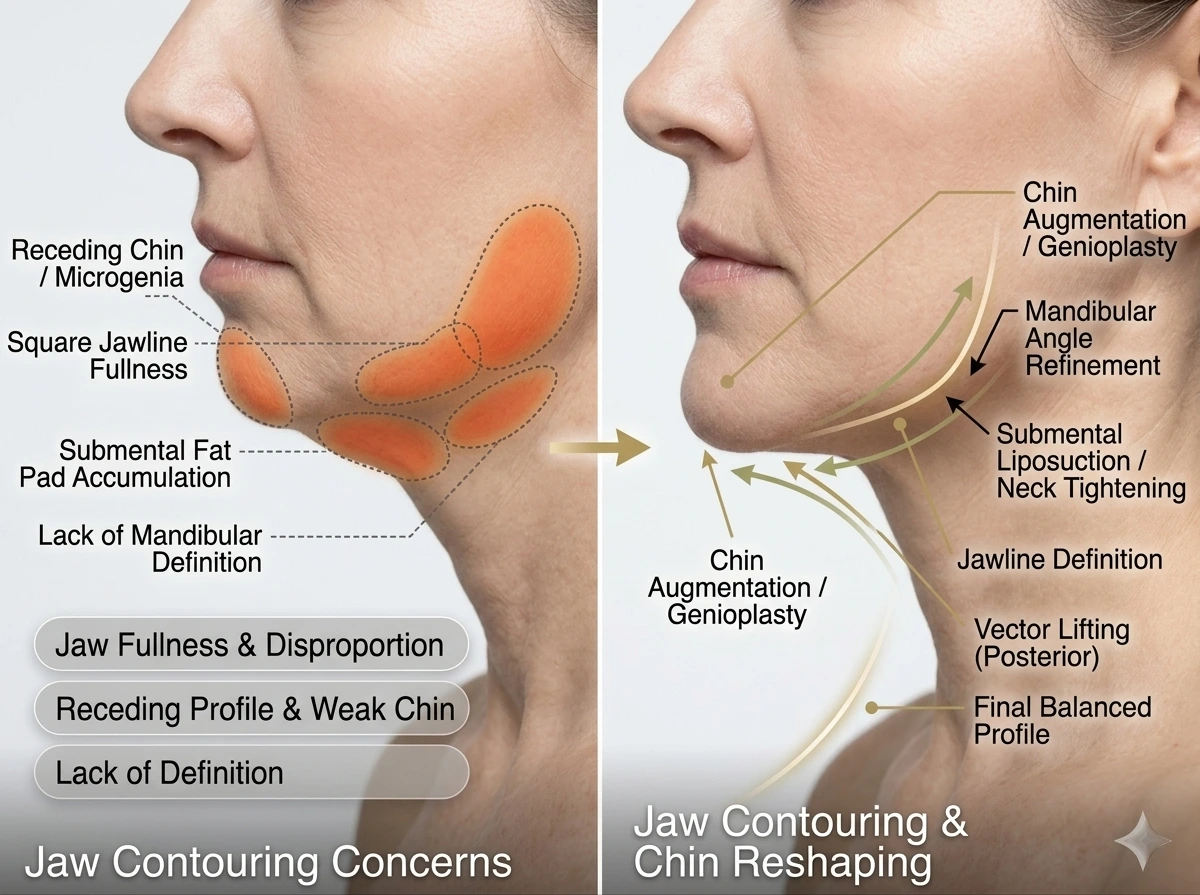
What's the Difference? Jaw Contouring and Jaw Reduction
Jaw contouring may reshape bone or soft tissue, while jaw reduction surgically narrows selected bone. Compare options, candidacy, recovery, risks and cost factors.
Aug 18, 2026
